You’ve built the map. You’ve sketched the mountains, named the rivers, and written three chapters of lore. But your list of fantasy kingdom names still doesn’t have one that hits hard enough. Sound familiar?
A great fantasy kingdom name does more than label a place on a map. It tells your reader what kind of world they’re stepping into. It sets the tone before page one. Whether you’re building a D&D campaign, writing a novel, or designing a fantasy map for a video game, the right name carries enormous weight.
Think about it. “Mordor” feels heavy and threatening. “Rivendell” feels peaceful and ancient. Neither name needs a description to work. That’s the power of a well-crafted fantasy kingdom name.
This list gives you 199+ fantasy kingdom names across every category. From dark empires to whimsical fairy tale realms, each name comes with a table explaining its vibe, its cultural roots, and where it fits best in your story.
Let’s get into it.
What Makes a Fantasy Kingdom Name Truly Powerful?
Not every name works. Some sound like random syllables thrown together. Others feel generic. The best fantasy kingdom names share three core elements: sound, meaning, and memorability.
Sound is everything. Hard consonants like K, D, and X signal danger and power. Soft vowels like A, E, and I create warmth or mystery. Your kingdom’s name should match its personality.
Meaning adds depth. Names rooted in Latin, Norse, or Gaelic feel ancient and earned. Even invented names benefit from borrowing phonetic patterns from real languages.
Memorability is the final test. If your reader forgets the name by chapter two, it’s not working. Short names are easier to remember. Longer names build lore but need a strong rhythm to carry their weight.
Pro-Tip: Read your chosen name out loud three times. If it flows naturally in dialogue, “The armies of [name] march at dawn,” it’s a keeper. Tolkien called this the “resonance test,” and it still holds.
Strong world-building starts with a name your audience feels, not reads. The rest of your lore follows naturally from there.
Dark & Mysterious Fantasy Kingdom Names
Dark fantasy kingdom names carry weight. They signal danger, corruption, and forgotten power. These names work best in grimdark novels, horror-fantasy settings, and villain-ruled empires in your D&D campaign.
The secret is in the consonants. Hard stops and fricatives make names sound threatening without any explanation needed. Names like Dreadmoor, Grimspire, and Shadowfen hit differently because the sounds themselves create unease.
| Name | Context & Vibe |
|---|---|
| Dreadmoor | A fog-covered swamp empire ruled by fear; perfect for undead lore culture |
| Shadowfen | A marshland dominion where dark magic seeps through the ground |
| Bloodreign | An empire built on conquest and sacrifice; fits war-heavy D&D campaigns |
| Ashenfel | A kingdom built on volcanic ash and broken promises |
| Wraithmoor | Open moorlands haunted by spirits; excellent for gothic fantasy settings |
| Soulblight | An empire where magic drains life directly from its citizens |
| Grimvault | A treasury-state built entirely on hoarded dark power |
| Deathmere | A lake kingdom with a long history of ritual sacrifice |
| Shadowthorn | A forest empire where the trees themselves are hostile to outsiders |
| Gloomhaven | A refuge for dark creatures and cursed souls across the realm |
| Blackmarrow | A kingdom where the very soil is poisoned by ancient evil |
| Cursed Reach | A borderland empire nobody willingly enters twice |
| Desolara | Sounds desolate and final; works perfectly for dying empires in decline |
| Grimtide | A coastal dark empire where the tides bring death to the shore |
| Darkhollow | An underground empire carved into cursed earth over centuries |
| Dreadfen | Swampland ruled by something ancient, patient, and awful |
| Skarroth | Harsh syllables, battle-scarred history; fits brutal conqueror empires perfectly |
Expert Insight: Linguists call this “phonetic symbolism.” Dark-sounding names consistently use K, D, G, R, and X sounds. When you’re building an evil realm, lean into those sounds deliberately and your audience will feel it before they process the meaning.
Read Also: 🎮199+Funny Valorant Names That Will Make You LOL in 2026 😂🔥
Light & Celestial Fantasy Kingdom Names
Magical fantasy kingdom names rooted in light, sky, and divine energy create a completely different atmosphere. These names suit high fantasy, divine kingdoms, and realms of ancient wisdom built around celestial power.
Vowel-heavy names like Elvarion, Luminara, and Aethoria feel open and ethereal. The sounds themselves invite trust and wonder. These work perfectly for novel writing and epic quests where the light kingdom stands in direct contrast to a dark empire.
| Name | Context & Vibe |
|---|---|
| Elvarion | Elven-inspired, golden-hour vibes; a classic high fantasy realm |
| Mysthollow | A kingdom wrapped in gentle mist; peaceful but full of layered secrets |
| Silvermist | Silver-toned, feminine energy; suits matriarchal celestial empires |
| Whisperwind | A sky-touched dominion where prophecy travels on the breeze |
| Spellbreak | A kingdom where old magic was shattered and painfully rebuilt |
| Luminara | Latin root “lumen” (light); radiant and divine; suits holy kingdoms |
| Dawnspire | A tower-city facing east, tied to sunrise rituals and new beginnings |
| Goldenmere | A lake kingdom where the water reflects pure gold at noon |
| Brightfall | A waterfall kingdom flooded with natural light year-round |
| Luminos | Clean and bright; works for any lore culture centered on knowledge |
| Skyhold | A fortress city above the clouds; strong name for sky kingdom empires |
| Cloudspire | A delicate sky kingdom built on floating stone platforms |
| Starholm | A quiet celestial settlement with deep astronomical traditions |
| Dawnveil | A kingdom existing at the magical border between night and day |
| Illuniath | Invented but feels ancient; strong choice for secretive light orders |
| Lumenveil | A kingdom where light itself serves as a protective magical barrier |
| Celestara | Feminine and cosmic; ideal for moon-goddess-ruled empires |
| Dawncroft | A small, humble kingdom carrying a powerful celestial destiny |
Pro-Tip: Soft names ending in “-ia,” “-ara,” or “-el” trend heavily in BookTok fantasy communities right now. They feel modern and elegant without losing their ancient quality. That balance is exactly what today’s fantasy readers want.
Read Also: 🚐 250+ Funny Camper Names That Will Crack You Up in 2026 😂
Ancient & Mythological Fantasy Kingdom Names
Ancient kingdom names borrow from the bones of real history. Latin, Greek, Norse, Gaelic, Sanskrit; these languages carry centuries of cultural weight. Drop one of their roots into a fictional name and it instantly feels earned in your world-building.
Names like Eldorath, Valthoria, and Arcanis Prime don’t need backstory to feel old. The phonetics do that work for you.
| Name | Context & Vibe |
|---|---|
| Eldorath | Old English roots; a founding kingdom with immense historical power |
| Valthoria | Roman-Nordic blend; suits an ancient senatorial empire |
| Mytherion | From “mythos”; a kingdom born directly from living legend |
| Arcanis Prime | The original source of all magical knowledge in your lore culture |
| Dravenholt | Germanic roots; a fortified ancient kingdom with very long memory |
| Elarion | Elven-root ancient name; feels pre-civilization and deeply wise |
| Aelinwood | Gaelic-adjacent; a sacred forest kingdom with druidic traditions |
| Eldrathil | Multi-syllabic and deeply ancient; suits oldest-civilization kingdoms |
| Valdris | Nordic short-form; a war-council empire with ancient codes of honor |
| Mythara | Clean and mythic; works for any founding-civilization kingdom |
| Astervane | From “aster” (star) and “vane” (direction); a navigation-based ancient empire |
| Eternum | Latin “eternal”; a kingdom claiming existence since time itself began |
| Solanthar | Sun-and-earth blend; an agricultural ancient civilization |
| Vethuris | Invented but phonetically ancient; suits mystery-cult kingdoms |
| Lortheval | Welsh-adjacent; a hidden valley kingdom with secret ancient knowledge |
| Mythveld | “Veld” (open land) meets myth; a plains empire of generational storytellers |
| Runevast | A wide ancient kingdom governed entirely by runic tradition |
| Vaelthor | Nordic-Celtic blend; a seafaring ancient empire of legendary explorers |
| Ancientum | Blunt and confident; a kingdom needing no other identity than its age |
| Solthara | Sun-rooted ancient kingdom; strong for solar-deity worship civilizations |
Expert Insight: Borrowing from dead languages is a widely accepted practice in fantasy naming. Be careful with living cultural languages, though. Using Gaelic roots for a Celtic-inspired realm is respectful. Misrepresenting a living culture’s sacred terms is not. Know the difference before you commit to a name.
Read Also: 199+ Goofy Ahh Names That Will Make You Laugh Out Loud in 2026 😆
Nature & Element-Inspired Fantasy Kingdom Names
Element-based fantasy kingdom names anchor your world in physical reality. Fire kingdoms feel volatile. Ocean kingdoms feel vast and unpredictable. Earth kingdoms feel immovable. Each element carries built-in story tension that your plot feeds on.
Fire fantasy kingdom names like Pyrothorn, Flamecrag, and Lavacrest work best in volcanic settings or conquest-driven empires. Ocean fantasy kingdom names like Aquarion, Thalassia, and Wavecrest suit trading empires and naval powers with deep maritime lore culture.
| Name | Context & Vibe |
|---|---|
| Pyrothorn | Fire and thorns; a volcanic empire with a dangerous, spiky border |
| Flamecrag | A rocky cliff kingdom engulfed in flame; fierce and dramatically visual |
| Ignislore | Latin “ignis” (fire) meets lore; a fire-magic academic empire |
| Cinderhold | A kingdom that rose from the ashes of a destroyed civilization |
| Lavacrest | An empire sitting at the summit of an active volcanic mountain range |
| Aquarion | Water-root; a kingdom where aquatic magic governs all civic life |
| Thalassia | Greek “thalassa” (sea); a classical ocean fantasy kingdom with naval dominance |
| Pearlspire | An ocean dominion built around pearl trade and sea-floor magic |
| Wavecrest | A coastal empire at the meeting point of two great ocean currents |
| Neptune’s Crown | A bold mythological ocean kingdom with divine sea-ruler origins |
| Stonehammer | Classic dwarven aesthetic; raw, powerful, and completely no-nonsense |
| Firebeard | A dwarven fantasy kingdom named after its legendary founding clan |
| Thornwood | A forest empire where the trees grow with natural defensive thorns |
| Verdania | From Latin “viridis” (green); a lush, prosperous agricultural empire |
| Mosshollow | A quiet, hidden forest kingdom deep in ancient woodland territory |
| Fernveil | A veiled forest realm where ferns grow over ancient ruins and history |
| Stormcrest | A sky-peak empire constantly battered by magical, violent storms |
| Mistwood | A forest empire hidden behind permanent, unnaturally thick natural mist |
| Oakenveil | An oak-forest kingdom protected by ancient natural magic veils |
| Embervast | A wide, ember-dusted empire sitting atop cooling volcanic plains |
Pro-Tip: Match your kingdom’s name element to its geographical placement on your fantasy map. A fire kingdom built on a coastline feels inconsistent. Geography and name should always reinforce each other. Your readers notice mismatches even when they don’t consciously register why.
Royal & Noble Fantasy Kingdom Names
Royal fantasy kingdom names need to sound wealthy, old, and in control. These names suit kingdoms with strong governance, inherited power, and political intrigue. They’re perfect for novel writing focused on court drama, succession wars, and diplomatic tension between powerful houses.
Names like Valoria, Crownreach, and the iconic Sapphire Throne carry instant prestige. You don’t need to explain the wealth. Your reader hears “royal” in the phonetics alone.
| Name | Context & Vibe |
|---|---|
| Valoria | Latin-rooted, feminine, powerful; a queen-led empire with deep tradition |
| Rosehaven | A safe, prosperous kingdom known for beauty and skilled diplomacy |
| Crownreach | A kingdom stretching its rule as far as its crown’s legal claim goes |
| Sapphire Throne | A wealthy ocean-adjacent monarchy with gemstone-based power economy |
| Queenstone | A matriarchal dominion built around a sacred founding stone |
| Aurelius | Latin “golden”; a sun-touched royal empire of law and high culture |
| Crownmere | A lake kingdom ruled through ancient royal bloodline rites |
| Imperion | Roman-adjacent; a formal empire with combined military and civic pride |
| Noblespire | A tower-city kingdom governed by a council of noble houses |
| Sovereignus | Sounds Latin and authoritative; a kingdom that refuses to bow to anyone |
| Regalia | Named after the objects of royal power; suits ceremonial monarchies |
| Goldspire | A prosperous realm with a gold-tipped central tower visible for miles |
| Thronefall | A kingdom in political decline; great for tragedy-focused world-building |
| Majestica | Lush and formal; a ceremonial empire built on public displays of power |
| Crownholm | A cold-climate royal dominion with strong Norse-adjacent traditions |
| Royalvast | A sprawling empire where royal bloodline controls enormous territory |
| Goldenveil | A prosperous kingdom hidden from outsiders by deliberate magical secrecy |
| Imperathon | A tireless empire; vast and built entirely for long-term conquest |
Expert Insight: Many royal fantasy names use a simple “prefix trick.” Combine a noble material (gold, crown, rose, sapphire) with a place-word (reach, haven, spire, stone). It’s a reliable formula that produces consistently strong results in world-building for political fantasy.
War, Conquest & Warrior Kingdom Names
Warrior kingdoms need names that hit like a war drum. These fantasy kingdom names suit military empires, conquest narratives, and any story where power is taken rather than inherited.
Names like Bloodwatch, Warholt, and Conquera signal aggression through pure phonetics. Short, punchy, and loaded with hard sounds that demand respect from the first read.
| Name | Context & Vibe |
|---|---|
| Bloodwatch | A fortress empire that monitors its enemies at all times without rest |
| Ironclad | A metal-armored empire that has never been defeated in open battle |
| Battlespire | A tower-fortress kingdom existing solely for military training |
| Warholt | Nordic-root; a brutal empire led by war-chiefs, not hereditary kings |
| Conquera | Feminine form of conquest; an elegant name for a ruthlessly brutal empire |
| Siegemoor | A flatland empire known specifically for its brutal siege warfare tactics |
| Warbane | A kingdom that destroys other kingdoms; the bane of every neighbor |
| Ironbolt | Fast, metallic, aggressive; suits a cavalry-focused military empire |
| Strikethane | “Thane” (warrior lord) plus strike; an empire of elite warrior-nobles |
| Bladefall | A kingdom where every political dispute ends in a formal duel |
| Warcroft | A crafted-for-war empire; industrial military production at scale |
| Crucible | A kingdom that forges its soldiers through brutal training and hardship |
| Ironmarch | An empire always moving, always expanding, always marching forward |
| Warveil | A warrior kingdom hidden behind layers of strategic misdirection |
| Bladespire | A fortress city ringed with blade-sharp defensive towers |
| Conquestum | Latinized conquest; a formal empire that documents every territory it takes |
| Steelthane | A thane-led empire where steel production is the direct source of power |
| Battlehold | A kingdom built inside a former battlefield; military history is its entire identity |
| Ironvast | A sprawling metalwork empire with armies too large to count accurately |
| Vorgrath | Invented guttural name; suits orcish or brutal barbarian empires perfectly |
Pro-Tip: V, R, and G are your best friends in war-themed naming. “Vorgrath,” “Grimclaw,” and “Ravenbolt” all feel physically aggressive because of those consonant combinations. Apply this principle to every name you build from scratch for a warrior empire.
Read Also: 😂 199+ Funny Prank Call Names (Epic & Hilarious Ideas for 2026)
Whimsical & Fairy Tale Fantasy Kingdom Names
Not every fantasy kingdom name needs to sound dangerous. Whimsical names suit cozy fantasy, children’s fiction, fables, and light-hearted adventures. This category is growing fast in the publishing world.
| Name | Context & Vibe |
|---|---|
| Picklethorn | Silly but specific; a small kingdom with an unusual agricultural product |
| Gooberlandia | Playful and absurd; perfect for middle-grade comedy fantasy audiences |
| Wobblewick | A wobbly little village-kingdom; charming and slightly chaotic by nature |
| Gigglemoor | A moorland full of laughing creatures; fits fable settings well |
| Chuckleville | A kingdom where joy is literally encoded into the law of the land |
| Sugarspire | A confectionery empire; great for children’s fantasy and classic fairy tales |
| Twinklegate | A gate-city kingdom where magic sparkles visibly at the entrance |
| Gigglecroft | A small farm-kingdom run by cheerful, chaotic, good-hearted inhabitants |
| Bubbleshire | A shire-style kingdom with literal bubble-magic floating in the air |
| Daisyvale | A flower valley kingdom; peaceful, colorful, and deeply charming |
| Honeymere | A lake kingdom where the water itself smells like honey all year |
| Lollipopshire | Unapologetically fun; clearly a children’s fantasy setting from the name alone |
| Buttercupshire | Soft and floral; a herbalist kingdom with a healing-focused culture |
| Muffinvale | A bakery-culture kingdom where food is the primary form of diplomacy |
| Snugglecroft | Warm, safe, and comforting; perfect for a cozy fantasy home base |
| Prancemoor | A moorland kingdom known across the realm for its festive celebrations |
| Glittervale | A glittery valley kingdom; fits fairy or pixie-ruled settings naturally |
| Fizzlewick | A small, chaotic kingdom where magic goes wrong more often than right |
Expert Insight: “Cozy fantasy” is one of the biggest trends in publishing right now. Books like “Legends & Lattes” proved that readers want warmth and comfort alongside adventure. Names like Picklethorn, Gooberlandia, and Gigglemoor fit perfectly in this growing genre space. Ignore this trend at your own risk.
Read Also: 269+ Funny Call of Duty Names (2026 😂🔥)Ultimate List to Dominate with Laughter
Fantasy Kingdom Naming Mistakes That Ruin Your World-Building
Even experienced writers make naming mistakes. The wrong fantasy kingdom name pulls readers out of the story fast. Here are 7 mistakes you need to avoid.
- Unpronounceable names. If your reader trips on it every time, they’ll stop caring. “Xszqvrath” isn’t mysterious. It’s frustrating and kills immersion.
- Copying existing names. “Gondolin,” “Arendelle,” and “Westeros” are taken. Your audience notices immediately and stops trusting your originality.
- Inconsistent naming conventions. If nine kingdoms have Latin-root names and one has a Japanese-root name, it breaks your lore culture logic completely.
- Too many hyphens. “Dar-Es-Valon-Kesh” is not a kingdom name. It’s a password nobody wants to type twice.
- Names that clash with your tone. A name like “Fluffton” in a grimdark war epic destroys the tone you’ve worked chapters to build.
- Repeating sounds across kingdoms. If every kingdom ends in “-thor,” your fantasy map feels repetitive and rushed.
- Ignoring phonetic symbolism. A peaceful farming realm named “Krax” sends the wrong signal. Sound and vibe must always align.
Pro-Tip: Run the “read-aloud test.” Read your kingdom’s name in this sentence: “The armies of [name] arrived at dawn.” If it flows naturally, you’ve got a winner. If it sounds clunky, keep working. This test catches problems no grammar check will ever flag.
Cultural Roots & Real-World Meanings Behind Fantasy Kingdom Names
The strongest fantasy kingdom names borrow from real languages. Arabic, Japanese, Sanskrit, and Gaelic all carry unique phonetic signatures that readers feel even when they don’t consciously recognize the source language.
| Real Language | Sound Profile | Fantasy Naming Application |
|---|---|---|
| Latin | Formal, authoritative, ancient | Imperium, Solarius, Eternum; suits governance-heavy empires |
| Norse | Harsh, rugged, battle-ready | Warholt, Valdris, Vaelthor; strong for warrior kingdoms |
| Gaelic | Soft, mysterious, lyrical | Aelinwood, Lortheval; great for hidden forest realms |
| Arabic | Flowing, warm, desert-toned | Ideal for desert realm naming in sun-scorched settings |
| Japanese | Clean, precise, layered meaning | Strong for honor-code empire names in eastern-inspired fantasy |
| Sanskrit | Deep, spiritual, ancient resonance | Suits divine or monastery-based kingdoms with religious governance |
Expert Insight: Tolkien used Finnish for Quenya (Elvish) and Welsh for Sindarin because he loved those languages and studied them deeply for years. Borrowing with genuine interest and respect produces richer, more credible results than surface-level imitation. Do your homework before borrowing from any living culture’s sacred linguistic traditions.
Fantasy Kingdom Name Trends in 2026
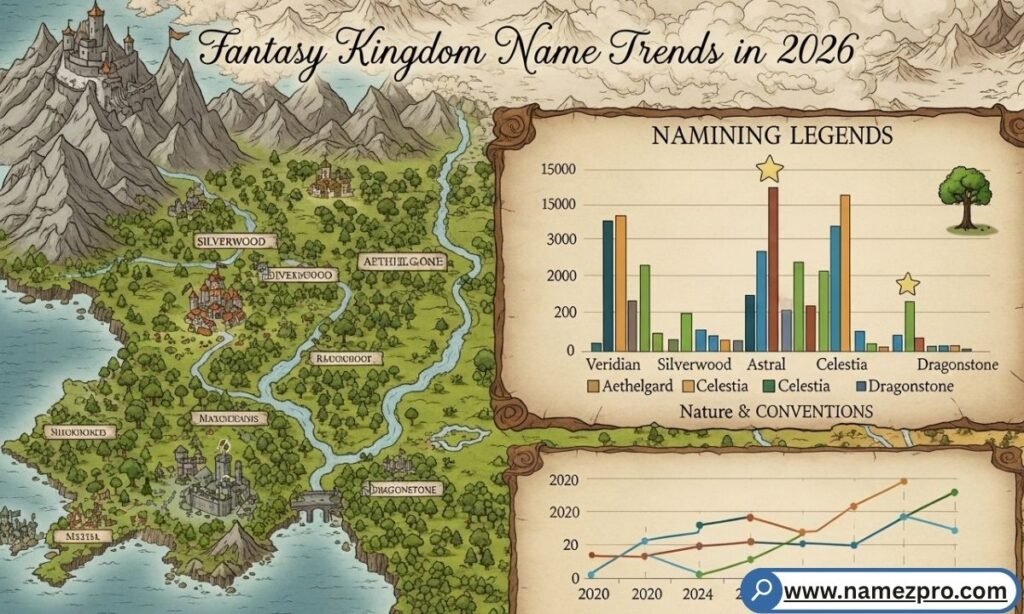
Fantasy kingdom names are evolving fast. Here’s what’s trending right now in publishing, gaming, and D&D campaigns across every major platform.
Slavic-inspired names are exploding in popularity. Eastern European phonetics give names a fresh, unfamiliar feel that readers love. They break from the tired Tolkien template and signal genuine creative originality.
African-inspired fantasy naming is rising fast too. Names drawing from Swahili, Zulu, and Yoruba carry strong phonetic power and create genuinely original world-building that stands out from the Western European fantasy default most readers have seen hundreds of times.
BookTok trends show soft, vowel-heavy names outperforming harsh consonant names in romantic and cozy fantasy. If your story targets that audience, names like Silvermist, Celestara, or Auroria align with current reader tastes and trending aesthetics.
Video game influence is also significant. Games like Elden Ring proved that strange, invented-sounding names create instant intrigue. Short names with strong imagery outperform long compound names in video game marketing every single time.
Pro-Tip: Check trending fantasy hashtags on BookTok and Reddit’s r/worldbuilding before finalizing your kingdom name. If your name already exists in a popular game or book franchise, rename it. Originality in novel writing matters more than ever in a crowded market.
How to Create Your Own Fantasy Kingdom Name From Scratch
You don’t need a generator. You need a formula and five focused minutes.
Step 1: Pick a root word from a real language. Latin, Norse, and Gaelic are safe starting points for classic fantasy that readers already trust.
Step 2: Add a suffix that signals geography or power. “-moor” (flat wetland), “-spire” (tower), “-holm” (island), “-veil” (hidden), “-reign” (power). Each suffix carries its own atmospheric weight.
Step 3: Say it out loud. Adjust the sounds until the name flows naturally in a sentence without stumbling.
Step 4: Check it doesn’t already exist in a popular franchise. A quick search solves this problem in 30 seconds.
Step 5: Test it with your target audience. Post it to a writing group or Discord server. Real reader reactions tell you more than any formula.
Expert Insight: The “3-second rule” is simple. Say your kingdom name once to someone unfamiliar with your story. Wait three seconds. If they ask “what was that called again?” it’s not strong enough yet. A powerful fantasy kingdom name sticks on first contact, every time.
Strong world-building always builds on a foundation of names your audience trusts, remembers, and feels in their gut.
FAQs
What are some good fantasy kingdom names for a D&D campaign?
Valoria, Dreadmoor, and Thornwood are strong choices because they are easy to pronounce and instantly convey a clear tone.
Should my kingdom name have a specific meaning or root language?
While not mandatory, borrowing phonetic patterns from Latin, Norse, or Gaelic gives the name an ancient, earned weight that feels authentic.
How do I avoid accidentally copying a famous kingdom name like Mordor?
Run a quick Google search and check a D&D wiki before finalizing; if it exists in a major franchise, change a syllable or prefix.
What is the difference between a kingdom name and an empire name?
A kingdom implies a single ruler with defined borders, while an empire suggests multiple conquered territories under one dominant central power.
What is the “read-aloud test” for naming a realm?
Read the sentence “The armies of [name] march at dawn.” If it flows naturally without tripping you up, the name is a keeper.
Final Thoughts
A great fantasy kingdom name is your story’s first impression. It sets tone, signals genre, and tells your reader what kind of world they’re walking into before a single line of dialogue is spoken.
You’ve now got 199+ fantasy kingdom names across every category. You have a naming formula, cultural trend insights, a mistakes checklist, and a read-aloud test that works every time. The tools are all here.
Pick the name that fits your world, run the test, and trust your instincts. Your kingdom is waiting.
Which name from this list speaks to your story? Drop it in the comments.