Understanding the nonchalant definition is the key to mastering modern communication, especially as the term evolves through 2026 social media trends. You’re in a group chat, someone says, “Why are you always so nonchalant about everything?” and you freeze. Do you say thank you? Apologize? Google the slang context secretly under the table?
Before you reply, you need to know exactly how nonchalant usage has shifted from a simple dictionary term to a specific “vibe” on social media.
Here’s the thing. The nonchalant definition trips people up constantly not because it’s complicated, but because it means different things depending on where you use it. In a job interview, being nonchalant reads as confident and composed. On a first date, it might come across as emotionally distant or hard to read. On TikTok in 2026? It’s practically a personality goal that millions of people are actively chasing.
Nonchalant means appearing calm, cool, and unbothered even when life is anything but.
But that one-line answer barely scratches the surface. This word has French roots, a 300-year history, and a brand-new life in digital culture and modern slang. Whether you’ve seen it in Instagram captions, heard it dropped in a song, or spotted it flooding a TikTok comment section you’re about to understand exactly what it means, where it came from, and how to use it correctly in every situation.
Let’s get into it.
Pro-Tip: The nonchalant definition has evolved significantly from its original 18th century aristocratic usage. Today’s online slang version carries a completely different emotional weight — understanding both versions helps you use the word like a genuine pro in any context.
What Does Nonchalant Mean? The Core Nonchalant Definition Explained
Let’s start with the basics but make them interesting.
The nonchalant definition describes someone who appears calm, relaxed, and unconcerned about things that would normally stress other people out. It’s that person who gets called into the boss’s office and walks out looking like they just had a casual chat about the weather. Nothing rattles them. Nothing shows.
Nonchalant (adjective) feeling or appearing casually calm and relaxed; not displaying anxiety, interest, or enthusiasm.
But here’s what most definitions miss. Nonchalant isn’t just about being calm it’s about making that calmness visible. It’s a performed ease. A cool vibe that says “nothing bothers me” whether or not that’s actually true underneath the surface.
The word traces directly back to French nonchaloir meaning “to be unconcerned” or “not to care.” It entered the English language in the 18th century, imported alongside the aristocratic elegance of French culture and manners. Back then, showing too much excitement was considered genuinely vulgar. The upper class cultivated deliberate emotional distance as a social skill. Being nonchalant meant you were above it all composed, refined, untouchable.
Fast forward to 2026, and that word evolution has come full circle. What was once an aristocratic pose is now a Gen Z aesthetic and a TikTok movement.
Pronunciation tip: non-shuh-LANT stress always lands on the last syllable. The French roots are directly responsible for that, and getting it wrong undermines the very cool vibe the word is supposed to project.
The biggest misunderstanding most people have? Confusing nonchalant with rude or arrogant mixup behavior. Being nonchalant doesn’t mean someone doesn’t care about you specifically. It means they carry a general air of quiet confidence and emotional distance from situations that would make most people visibly anxious. That’s a very different thing and the distinction matters a lot in daily conversations.
Here is the Table
| Context | Nonchalant Reads As |
|---|---|
| Work meeting | Confident, composed |
| First date | Mysterious, possibly disinterested |
| Crisis situation | Calm leader |
| Social media caption | Effortlessly cool |
| Heated argument | Unbothered, hard to rattle |
Expert Insight: Mispronouncing nonchalant in a professional setting often undermines the very self-assurance the word describes. If you’re calling someone nonchalant, say it with the confidence the word deserves.
Nonchalant Definition in Text How It Shows Up in Daily Conversations
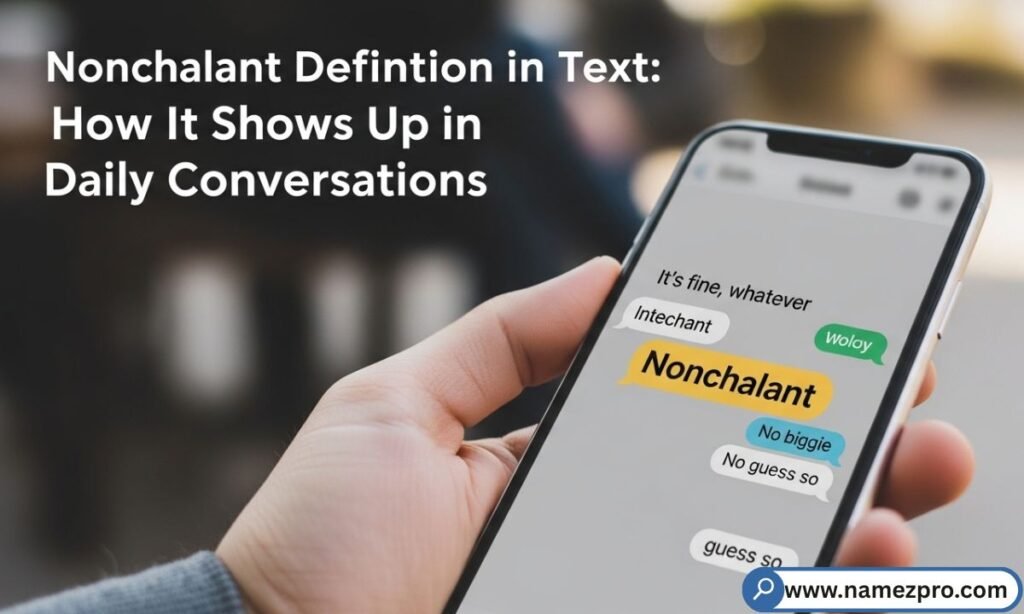
and why it hits different every single time.
The nonchalant meaning in text isn’t always about the word itself it’s about the behavior the word describes. In text messages and online chats, being nonchalant is a communication style that people either find magnetic or deeply frustrating depending on which side of it they’re on.
You know that friend who takes four hours to reply with “lol k”? That’s nonchalant texting also known as dry texting with a cool vibe attached to it. They’re not struggling to think of something clever to say. They genuinely don’t feel the pressure to perform enthusiasm they don’t feel. And in 2026, that reads differently depending entirely on the relationship context.
Here is the table
| Message Received | Nonchalant Reply | What It Signals |
|---|---|---|
| “Are you upset with me?” | “Nah, I’m good.” | Emotional detachment or genuine calm |
| “We need to talk.” | “Sure, whenever.” | Unbothered attitude, no panic |
| “Did you see what happened?!” | “Yeah.” | Classic dry texting, minimal reaction |
| “I miss you.” | “Aw.” | Emotionally distant, hard to read |
| “You free tonight?” | “Maybe, idk.” | Nonchalant vibe, non-committal |
Short replies. Late responses. Zero exclamation marks. No emojis. That’s the nonchalant texting formula in 2026, and it shows up everywhere from WhatsApp responses to Snapchat snaps.
People mix up dry texting and nonchalant texting constantly and here’s the distinction that matters. Dry texting is short and genuinely boring, with no thought behind it. Nonchalant texting feels intentional. The person isn’t struggling to respond. They don’t feel the need to perform enthusiasm they don’t genuinely have. That’s self-assurance not laziness or disinterest.
The problem shows up in dating talks specifically. When one person is anxiously waiting for a detailed, warm reply and gets “k” back that gap in text vibe expectations causes real friction. Neither person is necessarily wrong. They’re just operating from completely different online usage communication styles.
The key is context. In an established friendship, nonchalant texting is comfortable and natural. In a new romantic situation, it can create wrong interpretations that damage something before it even gets started.
Pro-Tip: In dating talks and new relationships, a nonchalant communication style is frequently misread as disinterest or emotionally unavailable behavior. But research into casual use communication patterns consistently shows that people with genuine quiet confidence naturally text this way — it’s not a game they’re playing, it’s simply their mature tone in action.
Read Also: GTS Meaning in Text: What It Really Means and How People Use It Online in 2026
Nonchalant Definition on Social Media TikTok, Instagram & Snapchat 2026
and this is exactly how it happened.
If you’ve spent any serious time on TikTok in 2026, you’ve seen the nonchalant energy trend absolutely everywhere. It started as a vibe that certain creators projected then exploded into a full-blown online trend, a personal brand, and honestly a lifestyle movement that millions of people are actively participating in.
Search “nonchalant era” on TikTok right now and you’ll find tens of millions of videos. The concept is straightforward people documenting their journey toward becoming genuinely unbothered. Less reactive. More composed. More effortlessly cool in the face of drama, rejection, and everyday chaos.
What “nonchalant era” TikTok content looks like in practice:
- “Day 3 of my nonchalant era didn’t text back for 6 hours and genuinely felt nothing”
- Montages of people completely unbothered by drama, rejection, or bad news
- Caption trends like “she’s in her nonchalant era 👏” and “nonchalant szn loading”
- Transformation videos showing before and after emotional reactions to the same situation
It’s not just meme usage. It’s a genuine lifestyle aspiration built around emotional distance from things that don’t serve you and that message is resonating deeply with audiences burned out on performative hustle culture.
On Instagram, nonchalant shows up in caption trends and as a full visual aesthetic:
| Caption | Vibe It Signals |
|---|---|
| “Nonchalant szn 🥶” | Cool personality, unbothered energy |
| “Too nonchalant to explain.” | Mysterious aura, confident silence |
| “She moves different. Nonchalant.” | Admiration effortless style |
| “Living nonchalant, loving it.” | Lifestyle flex, self-assurance |
| “Nonchalant but make it fashion.” | Attractive vibe, composed presence |
On Snapchat snaps and WhatsApp responses, nonchalant behavior shows up as one-word replies, hours between responses, and a deliberate absence of reaction emojis. People who communicate this way aren’t cold or uncaring they’ve simply adopted a text vibe that prioritizes self-assurance over constantly performing warmth they may not feel in that exact moment.
Expert Insight: Nonchalant is now among the top 50 most-used adjectives in English-language Instagram captions in 2026 up from outside the top 200 just three years ago. That kind of rapid rise tracks directly with Gen Z’s growing cultural emphasis on emotional distance as a form of cool personality expression and identity.
Nonchalant Definition vs Similar Words Complete Comparison
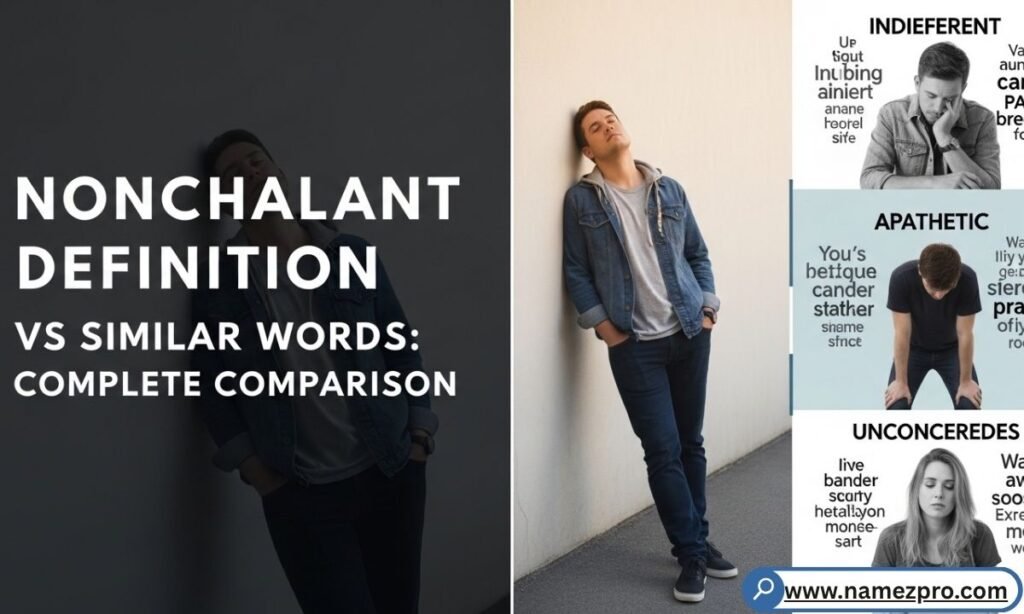
This is where most people get genuinely confused. Nonchalant sounds like several other commonly used words and gets used interchangeably with them in everyday speech. But each one carries a subtly different nonchalant meaning that absolutely matters depending on context.
| Word | Core Meaning | Emotional Tone | 2026 Vibe |
|---|---|---|---|
| Nonchalant | Calm, casually unbothered | Neutral to positive | Cool vibe, quiet confidence |
| Unbothered | Not affected by negativity | Positive, empowered | Gen Z power move |
| Indifferent | Doesn’t care either way | Neutral to negative | Cold, unimpressed |
| Aloof | Distant, unfriendly | Negative | Unapproachable |
| Stoic | Emotionally controlled | Positive, strong | Mature, disciplined |
| Detached | Emotionally disconnected | Negative | Emotionally unavailable |
Here’s the kicker nonchalant is the only word in this entire list that carries a genuinely positive connotation in modern slang and chat slang culture while still acknowledging a real degree of emotional distance. Unbothered is louder and more defiant. Stoic is more serious and disciplined. Nonchalant sits right in the middle calm relaxed, effortlessly cool, and impossible to rattle without even trying.
Three common confusions that come up constantly in online usage:
The rude assumption People assume someone being nonchalant is being deliberately dismissive or disrespectful. In reality, nonchalant behavior usually reflects genuine self-assurance not indifference toward the specific person they’re talking to.
The arrogant mixup In work behavior settings especially, a nonchalant personality gets misread as arrogance or superiority. But there’s a clear and important difference. Arrogance involves actively looking down on others. Nonchalant energy involves composure and ease two completely different things.
Overuse slang In 2026’s online slang culture, nonchalant gets applied to situations where it simply doesn’t fit. Not every calm person is nonchalant. Some are just quiet, introverted, or tired.
Pro-Tip: Before calling someone nonchalant, ask yourself are they performing calm or genuinely calm? The real nonchalant definition implies complete effortlessness. If someone is visibly trying to appear unbothered, that’s actually the opposite of genuine nonchalant energy.
Read Also: 250+ Funny Hogwarts Legacy Names (Best Ideas for 2026) 🪄😂
How to Use Nonchalant Correctly Real Life Examples in Sentences
Knowing the nonchalant definition is one thing. Using it correctly in real-life uses and everyday speech is something else entirely and the gap between the two trips people up more than you’d expect.
Formal usage examples:
- “The CEO remained completely nonchalant during the press conference despite the mounting controversy around her.”
- “His nonchalant approach to the salary negotiation actually worked in his favor he walked out with a 20% raise.”
- “She delivered the news with a nonchalant confidence that immediately calmed everyone in the room.”
Casual and informal usage examples:
- “Why are you so nonchalant about the exam tomorrow? Aren’t you nervous at all?”
- “He texted back ‘k’ fully nonchalant, like nothing happened between us.”
- “She’s got that nonchalant energy that just makes everyone around her calm down automatically.”
In dating talks, nonchalant behavior creates a genuinely complicated dynamic that plays out differently at every stage:
| Situation | Nonchalant Behavior | Likely Result |
|---|---|---|
| Early dating | Slow replies, calm demeanor | Reads as mysterious aura often attractive |
| Established relationship | Unbothered by small arguments | Mature tone stabilizing and grounding |
| Partner shares major news | Minimal visible reaction | Reads as emotionally distant genuinely damaging |
| Conflict or argument | Stays calm under pressure | Quiet confidence naturally de-escalating |
| Making plans | Non-committal, flexible | Can feel like detached attitude frustrating |
The context shift between early dating and an established relationship is particularly important here. What reads as an attractive vibe at week two can read as emotionally unavailable at month six if the behavior never evolves.
Expert Insight: Relationship coaches in 2026 are increasingly drawing a clear line between healthy nonchalant personality traits composure, self-assurance, not sweating genuinely small things and problematic detached attitude patterns that signal true emotionally unavailable behavior. The nonchalant definition itself is completely neutral. Context and consistency determine whether it’s a genuine strength or a slow-burning relationship problem.
Nonchalant in Pop Culture Music, Movies & Meme Usage in 2026

The nonchalant definition didn’t just survive into digital culture it genuinely thrived there and found an entirely new audience that the word never had before.
Artists across hip-hop, R&B, and pop have embraced nonchalant energy as a central lyrical theme for years. The core idea is always the same the coolest, most powerful, most magnetic person in any room is always the one who’s the least visibly reactive. Staying calm when everyone expects you to break. That’s nonchalant energy at its most compelling.
This musical framing of nonchalant signals three things simultaneously attractive vibe, effortless style, and mysterious aura. Three qualities that translate perfectly into themes about confidence, emotional independence, and unbothered living that dominate popular culture in 2026.
In movie and TV contexts, nonchalant characters are almost always the ones audiences find most compelling. The detective who never flinches. The lead who walks away from explosions without looking back. The love interest who somehow wants you more when you need them less. All of them are projecting the same nonchalant personality composed, magnetic, and impossible to read completely.
Meme usage of nonchalant absolutely exploded in early 2026 with formats that spread across every major platform:
- “Me, nonchalant, watching everything in my life fall apart simultaneously 🧍”
- “Nonchalant mode: fully activated. Drama: completely ignored.”
- “She said we need to talk. Me: *nonchalant shrug emoji* Sure.”
- “My nonchalant era started the moment I stopped explaining myself to people.”
These formats work because they capture the tension between emotional detachment and real-life chaos — a tension that most people genuinely relate to in online slang culture. The humor comes from the gap between how calm the person appears and how chaotic reality actually is.
Pro-Tip: Meme usage of nonchalant has genuinely helped younger audiences understand the word’s nonchalant meaning more accurately and intuitively than textbook definitions ever managed to. Seeing it applied in relatable chat situations makes the online usage click immediately in a way that dictionary entries simply can’t replicate.
The Psychology Behind Nonchalant Personality & Emotional Distance
Here’s where the nonchalant definition gets genuinely deep and where understanding it actually changes how you interpret other people’s behavior.
Being nonchalant isn’t just a communication style or a social media aesthetic. For many people, it’s a deeply rooted psychological pattern that developed over years of specific life experiences. And understanding why someone develops a nonchalant personality changes everything about how you interpret what they’re doing.
Natural nonchalant personality what it actually looks like:
- Consistently calm and composed across all situations, not just low-stakes ones
- Not performing cool vibe for an audience genuinely wired this way neurologically
- High emotional regulation and naturally low reactivity to external stressors
- Scores consistently high in self-assurance and psychological security research
Learned nonchalant behavior what it actually looks like:
- Developed gradually as a psychological defense mechanism against emotional pain
- Emotional distance used deliberately to avoid vulnerability and potential rejection
- May mask significant underlying anxiety with an outward detached attitude
- Extremely common in people with avoidant attachment styles formed in childhood
The single most important difference between these two? Genuine nonchalant personality traits show up with remarkable consistency in good times, bad times, high-stakes situations, and completely mundane ones. Performed nonchalant behavior, on the other hand, tends to crack and collapse under real, sustained pressure when the emotional stakes get high enough.
The nonchalant energy that looks identical from the outside can come from completely opposite internal sources genuine security or deep-seated fear of intimacy. That distinction matters enormously in relationships, friendships, and professional dynamics.
Expert Insight: Psychologists and therapists in 2026 increasingly distinguish between nonchalant energy as a genuine expression of emotional maturity and composure versus emotionally unavailable behavior that simply masquerades as calm. The former builds trust and deep connection over time. The latter quietly erodes both without either person fully understanding why.
Nonchalant Synonyms & Antonyms Complete Quick Reference
Top synonyms with context:
| Synonym | Best Used When |
|---|---|
| Unbothered | Social media, casual use, Gen Z contexts |
| Composed | Professional settings, formal situations |
| Laid-back | Informal spoken tone, friendly contexts |
| Unruffled | High-pressure situations where calm stands out |
| Cool | Dating talks, social situations |
| Collected | Work environments, leadership contexts |
| Easygoing | Positive, warm, friendly everyday contexts |
| Detached | When the emotional distance element is the focus |
Antonyms of nonchalant:
| Antonym | What It Signals |
|---|---|
| Anxious | Opposite of calm relaxed |
| Agitated | High reactivity, visible stress |
| Intense | High emotional investment in outcomes |
| Overwrought | Complete emotional overload |
| Enthusiastic | Opposite of unimpressed, high energy |
FAQs Nonchalant Definition
Nonchalant means appearing calm, cool, and unbothered whether or not you actually feel that way on the inside. It’s the art of making composure look completely effortless.
She walked into the meeting completely nonchalant, like she hadn’t been panicking in the bathroom five minutes before it started.
Generally positive especially in modern slang and digital culture. Context determines whether it reads as admirable cool personality or concerning emotionally distant behavior in a specific situation.
Unbothered is louder, more defiant, and more declarative it’s almost a statement. Nonchalant is quieter, more effortless, and more inherent it’s a disposition. Both signal cool personality but with meaningfully different emotional energy behind them.
The “nonchalant era” TikTok trend drove massive online usage starting in late 2025 and accelerating through 2026. Gen Z collectively embraced nonchalant energy as a direct antidote to performative hustle culture and constant emotional availability expectations.
Usually yes it implies quiet confidence, self-assurance, and an effortless style that most people genuinely admire. In formal or professional settings, whether it reads as complimentary depends entirely on context and delivery.
Final Thoughts
The nonchalant definition is deceptively simple on the surface calm, unbothered, cool. But this word carries layers that most quick-search results completely miss and never bother to explore properly.
It carries historical roots in French aristocratic elegance that are 300 years old. It evolved steadily through 18th century formal English into today’s online slang and chat slang vocabulary. And it’s found an extraordinary second life on TikTok, Instagram captions, and Snapchat snaps as the defining nonchalant energy of a generation that genuinely values composure and quiet confidence over constant emotional performance.
Whether you’re dropping it in everyday speech, navigating dating talks, writing your next Instagram caption, or just finally understanding what someone meant when they called you nonchalant you’ve now got the complete picture.
Stay nonchalant. 🥶