
Last month my Twitter feed filled up with K-pop fans sharing a link labeled “Daum Cafe,” and I clicked without thinking twice. I landed on a page written entirely in Korean, with zero clue what I was looking at. Three days later, a friend texted me “DAUM bro, did you see this?” I had no idea what this word meant in either case. If you’re here searching for Daum meaning, chances are you’ve hit the same wall. Here’s the thing: Daum isn’t one word with one definition. It’s two entirely different things sharing the same four letters, and figuring out which one you’re looking at changes the whole conversation.
This guide breaks down every version of Daum meaning you’ll run into online. It covers the slang reaction people drop in texts and TikTok comments, plus the real Korean company behind those fancafe links. By the end, you’ll know which Daum someone means. You’ll also know how to pronounce it and how to reply when a friend sends it your way.
What Does Daum Mean, Exactly? (Quick Answer)
The short answer is Daum carries two separate meanings, and neither one works as an official texting acronym like LOL or IMO. Understanding Daum meaning starts with knowing which category applies to what you’re reading.
Part of the confusion comes down to how the word travels. A K-pop stan account posts a Daum link one minute, and a gamer types “Daum” after a lucky win the next. Both spellings look identical on screen. Search engines and confused readers lump them together anyway, even though the two share nothing beyond four letters.
Quick Answer: Daum usually means one of two things. Online, in texts and comments, it’s a stylized spelling of “damn,” used as a reaction to something surprising or impressive. In Korean contexts, Daum refers to a major South Korean web portal, similar to Yahoo, which also runs the fan community platform Daum Cafe.
Before going deeper, here’s a fast way to sort out which meaning fits your situation:
- Saw it in a text or TikTok comment reacting to something wild → slang for “damn”
- Saw it attached to a K-pop fan link, forum, or Korean website → the web portal
- Saw it as someone’s username or nickname → likely a personal pick, not a hidden meaning
- Heard a friend say it out loud in one quick beat → slang
- Saw Korean characters (다음) sitting near it → the portal
Most western readers searching Daum meaning land in the first two categories. The rest of this guide covers both in detail, plus a few situations landing somewhere in between.
Read Also: Cuh Meaning: What Does Cuh Mean in Slang, Texting, and on TikTok
How to Pronounce Daum (This Is Where Most People Mess Up)
Pronunciation is where a lot of confusion starts, and it’s rarely covered anywhere else. Daum meaning shifts depending on how you say it, which sounds odd until you hear both versions side by side.
When Daum works as slang for “damn,” people say it fast, in one syllable. It comes out close to “dawm” or “dum,” rhyming with the word it’s replacing. It’s built to sound casual and quick, matching how texting shorthand shrinks longer, drawn-out reactions into something snappier.
The Korean word behind the web portal tells a different story. Daum comes from 다음, pronounced closer to “dah-eum,” two distinct syllables. Korean speakers wouldn’t compress it into one fast sound the way English internet slang does. Most guides never mention this phonetic spelling gap. It explains why native Korean speakers sometimes look confused when someone reads the portal name out loud using the slang pronunciation instead.
Here’s a simple breakdown to keep the two straight:
| Version | How It Sounds | Where You’ll Hear It |
|---|---|---|
| Slang Daum | “Dawm” or “Dum” (one syllable) | Texts, TikTok, casual chats |
| Korean Daum | “Dah-eum” (two syllables) | Korean media, fancafe links, portal mentions |
Bottom line: if someone says it fast and it rhymes with “damn,” it’s the slang version. If someone says it slowly with two clear beats while discussing a Korean website, they mean the portal. Getting this right saves you from sounding lost the next time it comes up in conversation.
Daum Meaning in Text Messages
When people search daum meaning in text, they’re almost always asking about the slang version. In texting, Daum stands in for “damn.” It gets dropped into a message the same way you’d type “wow” or “omg.”
It works as a reaction word first and foremost. A friend shares news, a photo, or a wild story, and “Daum” lands as the reply. It expresses surprise, admiration, or a bit of shock, without much typing effort involved.
Text Message Examples
Example 1: A: Did you see his new car? B: Daum, that’s expensive.
Example 2: A: I got a perfect score on the exam. B: Daum! Nice work.
Example 3: A: I ran a whole marathon today. B: Daum, respect.
Example 4: A: My landlord raised rent again. B: Daum. Sorry to hear that.
Notice how the tone flips completely between these four messages. The first three lean toward hype and admiration, while the fourth carries sympathy instead. Daum bends to whatever emotion the surrounding sentence sets up. This is exactly why it spread so quickly across texting culture.
Common Phrases and What They Mean
A quick look at common phrases and how they land:
| Example / Context | What It Means / How It Feels |
|---|---|
| “Daum, that’s wild” | Genuine shock at unexpected news |
| “Daum bro” | Casual admiration, often about looks or luck |
| “Daum she killed that outfit” | Compliment, tied to being impressed |
| “Daum, again?” | Mild frustration mixed with disbelief |
The daum slang meaning stays flexible enough to cover excitement, sarcasm, and everything between. This flexibility is part of why it spread fast in texting culture. When it comes to daum vs damn, the two work almost interchangeably in casual conversation, with Daum reading slightly softer and more playful. Punctuation shifts the tone too. “Daum!” with an exclamation point reads excited, while a flat “Daum.” with a period reads closer to disappointment.
Read Also: ISG Meaning in Text: What This Popular Slang Really Means
Daum Meaning in Chat, DMs & Gaming (Discord)
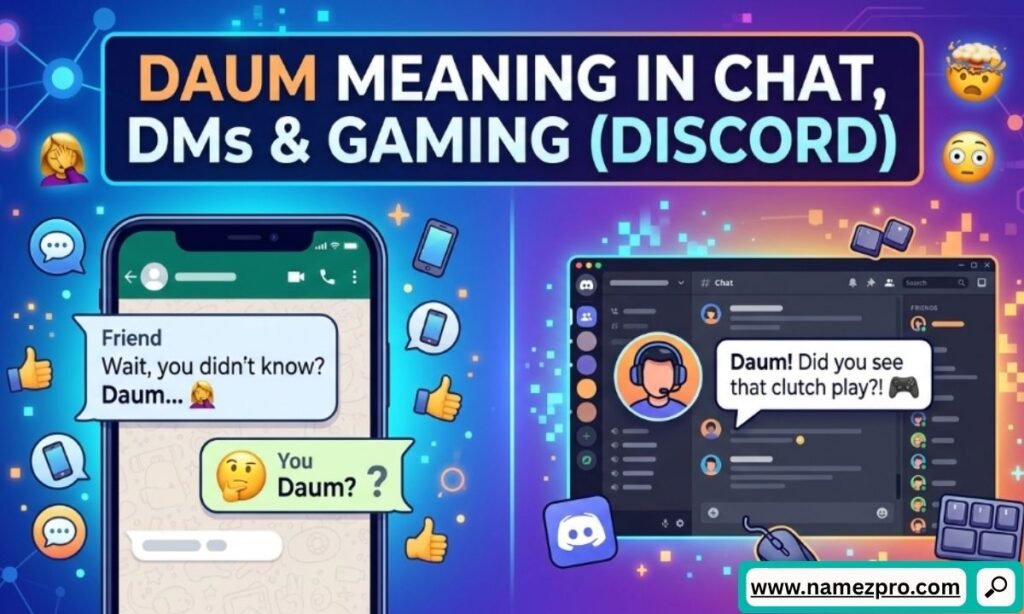
Daum meaning in chat works the same way it does in texts, though group settings like Discord and gaming lobbies add their own flavor. In a fast-moving chat, one-word reactions carry weight, since nobody wants to type a full sentence mid-match.
In gaming voice chats and Discord servers, “Daum” pops up after a clutch play, a lucky item drop, or a rage-inducing loss. It works as a quick nod, keeping the pace of the conversation moving without slowing anyone down.
Example: Player 1: I clutched a 1v4 solo. Player 2: Daum, no way. Player 1: I’m still shaking lol.
Korean-focused Discord servers and online forums tell a different story. If someone writes “found it on Daum” inside a conversation about Korean news or shopping, they’re pointing to the web portal. It’s not a reaction word here. Mixing up these two contexts on a mixed international server often leads to a confusing exchange. One person reacts to a game clip while another discusses a Korean shopping site, both typing the same four letters for entirely different reasons.
The trick with chat and DMs is speed. People read Daum in context almost instantly, since the surrounding messages already set the tone. A one-word “Daum” after a screenshot of a bad grade reads completely different from “Daum” after someone posts a new PC build. Friend groups also tend to build inside jokes around slang like this. One group chat might use Daum purely for sarcasm, while another leans on it for pure hype. Whichever pattern catches on usually sticks around.
Read More Related Article: ASL Meaning in Text: What This Popular Acronym Really Means
Daum on Snapchat, TikTok, Instagram & WhatsApp

Daum meaning on TikTok, Snapchat, Instagram, and WhatsApp stays consistent with texting. Each platform still adds its own texture through emojis, comment sections, and reply habits.
On TikTok, Daum shows up constantly in comment sections under videos featuring impressive skills, attractive people, or expensive purchases. It’s frequently paired with fire or skull emojis to push the reaction further, something close to “Daum 🔥🔥🔥” or “Daum 💀 how.”
Snapchat example:
Friend 1: Look at my vacation photos. Friend 2: Daum, that place looks unreal.
Instagram comment example:
“Daum, this Reels edit went hard 🔥”
WhatsApp example:
A: I finished the whole project in one day. B: Daum, that’s fast.
Instagram comments and Reels replies tend to stay short, often simply “Daum” paired with an emoji, while Snapchat leans toward fuller replies since conversations there feel more personal. WhatsApp usage mirrors regular texting, since most threads happen between people who already know each other well. This makes the tone warmer and more familiar overall.
Emoji pairing patterns differ by platform too, and picking up on them helps you read the tone faster. TikTok comments favor fire or skull emojis for hype. Instagram leans toward heart-eyes or clapping hands under glow-ups and achievements. Snapchat replies often skip emojis entirely, since the photo or video already carries the reaction. Gen Z accounts tend to stack Daum with several emojis at once. Millennial replies usually keep it to one word and a single emoji, if any.
Across every platform, the daum reaction stays tied to genuine surprise or admiration. Nobody reaches for it to express boredom, since words like “meh” already cover indifference. If Daum shows up under a video, comment, or reply anywhere on social media, treat it as a compliment. It’s a sign the poster impressed someone, not a criticism of any kind.
Daum the Korean Web Portal, and Why K-Pop Fans Search This Term
This section covers the meaning most guides skip past. It’s likely the reason a good chunk of readers landed on this page in the first place.
A Quick History of Daum
Daum (다음) launched in South Korea back in 1995 as one of the country’s earliest web portals. It offered email, search, news, and community boards years before most western readers had gone online at all. In 2014, Daum merged with Kakao, the Korean technology company behind the messaging app KakaoTalk. This folded Daum’s services under a bigger umbrella, while keeping the Daum name alive on products like Daum Mail, Daum Search, and Daum Cafe.
For years, Daum sat alongside Naver as one of the two biggest homegrown search engines in South Korea. It played a role similar to what Yahoo once held in the US. Naver eventually pulled ahead in daily search traffic. Still, Daum held onto a loyal user base through its community boards and blogging tools. The fancafe system later became its most recognizable export to international audiences.
Why K-Pop Fans Land Here
Did You Know: Daum Cafe hosts thousands of fan communities for K-pop groups, and joining one is often the first time western fans run into the word Daum. This random link shared under a fan account’s post, the one asking for a Korean phone number or email to sign up, usually leads straight to a fancafe hosted on the Daum portal.
Western Gen Z and Millennial K-pop fans encounter this Daum meaning through fancafes constantly. They chase exclusive photocards, voting content, and direct posts from idols this way. This context has nothing to do with the slang meaning. Mixing the two up leads to funny misunderstandings. Some fans assume “Daum” is a secret K-pop code word instead of a company name behind a search engine. Once the Kakao connection clicks, Daum stops feeling like a mystery. It starts making a lot more sense as an everyday piece of Korean internet infrastructure.
Read Also: SOL Meaning in Slang: How It’s Used in Text Messages & Online Chats
Is Daum Meaning a Typo or Intentional?
Sometimes Daum meaning has nothing to do with slang or Korean websites at all, it’s simply autocorrect messing with someone’s phone.
Voice-to-text tools and predictive keyboards occasionally twist “Down” or “Damn” into “Daum.” This happens most on phones which picked up unusual spelling habits from earlier slang-heavy messages. Someone typing in a hurry might miss the swap before hitting send. This leaves the person on the other end puzzling over an odd word which slipped in by accident.
A few common situations where this shows up:
- Typing “I’m daum bad at this game” instead of “I’m damn bad at this game”
- Voice-to-text picking up “down” during a noisy call and outputting “Daum” instead
- A keyboard learning Daum as a “preferred” spelling after repeated slang use, then applying it in places where it doesn’t fit
This accidental version explains why some readers search Daum meaning right after getting a message which seems slightly off. If the sentence around it reads like a typo, with missing words or odd phrasing nearby, there’s a decent chance the sender’s keyboard took over. When in doubt, the rest of the message usually gives it away faster than the word by itself.
Here’s a fast way to tell the difference. Intentional slang Daum almost always stands alone as a reaction, often with its own punctuation. A typo version, by contrast, sits buried mid-sentence where “damn” or “down” would naturally fit. Reading the full line out loud, swapping in each candidate word, usually settles it within a second or two.
Daum vs Similar Slang: Dayum, Sheesh, Bruh, No Cap
Daum belongs to a bigger family of reaction words, and knowing where it fits clears up the daum slang meaning even further.
Each of these terms expresses a burst of surprise or admiration, though the intensity and tone shift from one to the next.
| Term | Meaning / Feel |
|---|---|
| Daum | Casual surprise, close to “damn,” medium intensity |
| Dayum | Same core idea as Daum, stretched out for extra emphasis |
| Sheesh | Amazement, often tied to skill or looks, high energy |
| Bruh | Disbelief or secondhand embarrassment, more flexible tone |
| No Cap | Confirms something is true, less of a reaction word |
Dayum meaning works almost like an exaggerated cousin of Daum, dragging out the vowel sound for extra drama, usually written with stretched letters like “dayuuum.” Sheesh carries sharper, more excited energy, often showing up under attractive photos or impressive stunts on TikTok. Bruh sits in a lane of its own, leaning more toward secondhand embarrassment or mild annoyance than genuine admiration. No Cap functions less like a reaction and more like a stamp confirming honesty.
Knowing these differences matters, since swapping one for another shifts the tone of a reply completely. Texting “Sheesh” under a friend’s gym progress photo reads as hype, while “Bruh” under the same photo might read as teasing instead. Daum sits comfortably in the middle of this whole family of internet expressions, flexible enough to cover both moods without picking a strong side.
None of these words are new inventions either. Reaction slang like this tends to build on older exclamations, stretching vowels or swapping letters for fresh energy every few years. Daum simply represents the current form this pattern takes for one specific spelling of “damn.”
Read Also: TBF Meaning in Text: What This Popular Acronym Really Means
Is It Okay to Use Daum Meaning in Everyday Conversations?
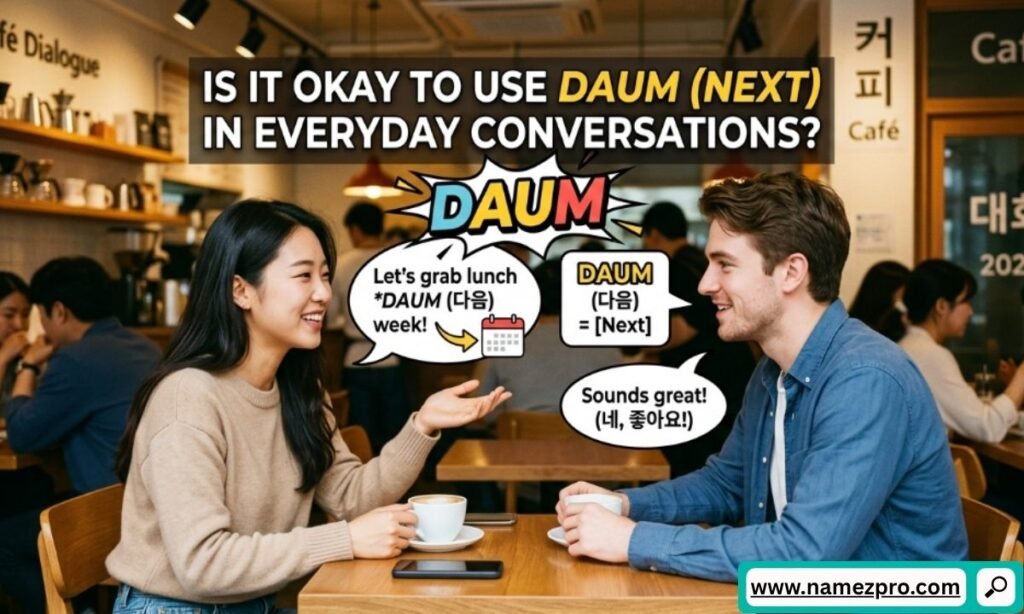
Daum works fine in almost every casual setting, though it’s worth knowing where it doesn’t belong.
Texting friends, commenting on social media, and chatting in Discord or gaming lobbies count as safe spaces for this kind of casual internet language. Nobody reads Daum as offensive, since it’s rooted in mild slang rather than genuine profanity, even though it borrows its sound from “damn.”
Where it falls flat is anywhere formal. Business emails, school essays, cover letters, and professional Slack channels call for real words like “impressive,” “surprising,” or “remarkable” instead. Dropping Daum into these settings reads as unpolished, even when no harm was intended by it.
A quick breakdown:
- Texting friends: fine
- Social media comments: fine
- Group chats and Discord: fine
- School essays: avoid
- Business emails: avoid
- Job interviews: avoid
Age plays a role here too. Gen Z reaches for creative spellings like Daum more often, while Millennials lean toward standard “damn” or its stretched-out cousin “dayum.” Neither version carries much social risk, though sticking with casual, familiar audiences keeps things simple. If there’s any doubt about whether a setting counts as formal, it likely does, and swapping in a standard word costs nothing.
Parents and teachers reading this over a teenager’s shoulder generally have little to worry about either. Daum reads as a spelling trick rather than an actual curse word on the page. Most schools treat it the same way they’d treat “dang” or “geez”: informal, but not worth a serious conversation.
Read Also: Alr Meaning in Text:What It Means, How to Use It, and Real Chat Examples
FAQ
What does Daum mean in a text message?
In texting, Daum usually works as a stylized spelling of “damn,” expressing surprise or admiration toward whatever was shared.
Is Daum the same as Damn?
Close, though not identical. Daum reads as a softer, more casual version, popular in texting and comments rather than spoken conversation.
What is Daum Cafe and why do K-pop fans use it?
Daum Cafe is a fan community platform run by the Korean portal Daum. K-pop fans join these fancafes for exclusive content, voting, and direct posts from idols.
Is Daum considered rude or inappropriate?
Not typically. It’s mild, informal slang, though it’s still worth avoiding in formal writing or professional settings.
How do you pronounce Daum correctly?
It depends on context: the slang version sounds like one quick syllable close to “damn,” while the Korean portal name sounds closer to two syllables, “dah-eum.”
Conclusion
Daum meaning boils down to context. Spot it in a text, a TikTok comment, or a group chat? It’s almost always slang for “damn,” a quick reaction to something surprising, impressive, or occasionally frustrating. Spot it attached to a Korean link, a fancafe sign-up page, or a mention of Daum Mail and Daum Search? Then you’re looking at one of South Korea’s biggest web portals, now part of the Kakao family.
Language online moves fast. Words like Daum show exactly how a single spelling carries two lives at once. One life is rooted in casual American and British texting habits. The other traces back through Korean internet history spanning three decades. Both versions are worth knowing. Most of our feeds mix gaming clips, K-pop content, and group chat screenshots these days anyway.
Next time this word shows up on your screen, run through the quick checklist from earlier in this guide. Where did it show up? Who sent it? What’s happening around it? Those three details answer the question almost every time.
A friend might text “Daum, that’s wild” after hearing your news. A K-pop fancafe link might land in your feed instead, asking you to sign up. Either way, you’re equipped to know what’s going on, without the confusion I dealt with a few weeks back. Two meanings, one word, and now you’re in on both.