Picture this: your friend texts a whole paragraph explaining why she skipped your birthday dinner. You type back one word: tbf. She stops responding for ten minutes, unsure if you were agreeing with her or quietly judging her. That’s TBF meaning in text in a nutshell: three letters that can carry a lot more weight than people expect.
Here’s the thing: TBF meaning in text isn’t complicated once someone walks you through it. But the way people use it in real conversations trips up even seasoned texters. It stands for “to be fair,” and it shows up everywhere from group chats to Instagram comments. People use three letters to soften an opinion, defend someone, or admit a point without sounding harsh. By the end of this guide, you’ll know the definition and how to read the tone behind it. You’ll also know when sending it works against you instead of for you.
Perhaps you’re a Gen Z reader who grew up typing it without thinking twice. Or you’re a millennial catching up on texting shortcuts your younger coworkers throw around. Either way, this guide breaks down TBF the way both US and UK readers use it day to day.
Speaking of things that need the right name, our free Name Generator can whip up ideas for your next group chat, gaming tag, or online handle in seconds. Give it a shot below.
Get instant name ideas no signup needed
What Does TBF Stand For?
TBF stands for “to be fair.” The abbreviation is a texting shortcut. The TBF full form reads almost exactly the way people say it out loud. Someone texts “tbf, he did warn us” and means “to be fair, he did warn us,” nothing hidden behind it.
TBF as a Discourse Marker
Here’s the part most guides skip: TBF works as a discourse marker, not a plain synonym. It signals a shift in the conversation. It’s a small pause where the speaker steps back and considers another angle before finishing the thought. Think of it as a verbal shrug paired with a fresh point of view.
A quick example:
Sam: He never texts back on time. Jordan: TBF, he’s been swamped with work this week.
Jordan isn’t disagreeing outright. Instead, Jordan adds context, nudging the conversation toward a fairer read of the situation. This is the core function behind TBF meaning in text messages. You’ll see it on Snapchat, in Discord servers, or in a group chat about weekend plans. It shows up anywhere people type fast and want to sound balanced without writing three extra sentences.
Where TBF Fits Among Texting Abbreviations
One small note worth remembering: the TBF abbreviation rarely stands alone as a formal term. Dictionaries define it. Its real life happens in casual chat, comment sections, and quick replies, not in essays or reports. Understanding what does TBF mean on paper is the easy part. Reading it correctly inside a live conversation is where things get interesting. Closing this gap is the whole point of the rest of this guide.
TBF sits inside a bigger family of internet abbreviations and texting shortcuts, alongside familiar names like LOL, BRB, and FR. What sets TBF apart from most of them is its job in a conversation. It isn’t reacting to something funny or announcing you’re stepping away. It’s steering the tone of a disagreement or a judgment toward something fairer. This small function is why TBF slang meaning sticks around across generations. You’ll find it in Gen Z group chats and millennial work banter alike.
See Also: Opps Meaning in Slang: Your Complete Guide to This Trending Term
Where TBF Comes From (It’s Older Than Texting)
Most slang guides treat TBF like it was born in a group chat sometime in the 2010s. Here’s the surprise: “to be fair” has been a well-worn phrase in British conversation for decades, long before phones had keyboards.
A British Football Commentary Habit
Old football commentary from the UK leaned on it constantly. Pundits opened sentence after sentence with “to be fair.” Fans started poking fun at commentators for treating it as filler, a phrase inserted before stating the obvious rather than offering genuine balance. The phrase picked up a reputation: sometimes sincere, sometimes a lazy habit used to fill airtime between real points.
Did You Know: Long before “TBF” hit a phone screen, British football commentators wore out the phrase “to be fair” so often, fans turned it into a running joke, using it to fill airtime before stating the obvious.
From Spoken Habit to Texting Shortcut
Texting culture picked up the full phrase and shortened it to three letters. It carried the same double life into digital conversation. Online, TBF slang meaning still splits the same way. Sometimes a person means it sincerely, softening a real disagreement. Sometimes it’s a reflex, tossed in before an opinion the speaker already planned to share anyway.
This backstory matters for anyone reading tone correctly. Once you know the phrase grew out of a habit of hedging out loud in everyday British speech, the modern texting version makes more sense. It didn’t appear overnight as internet slang invented by a phone screen. It got compressed for speed once typing replaced talking. Gen Z and millennials both inherited it without necessarily knowing where it came from. Knowing the backstory turns TBF from a random abbreviation into a small piece of everyday internet culture, one worth using with a bit more intention.
How to Use TBF in a Sentence (Grammar & Punctuation Rules)
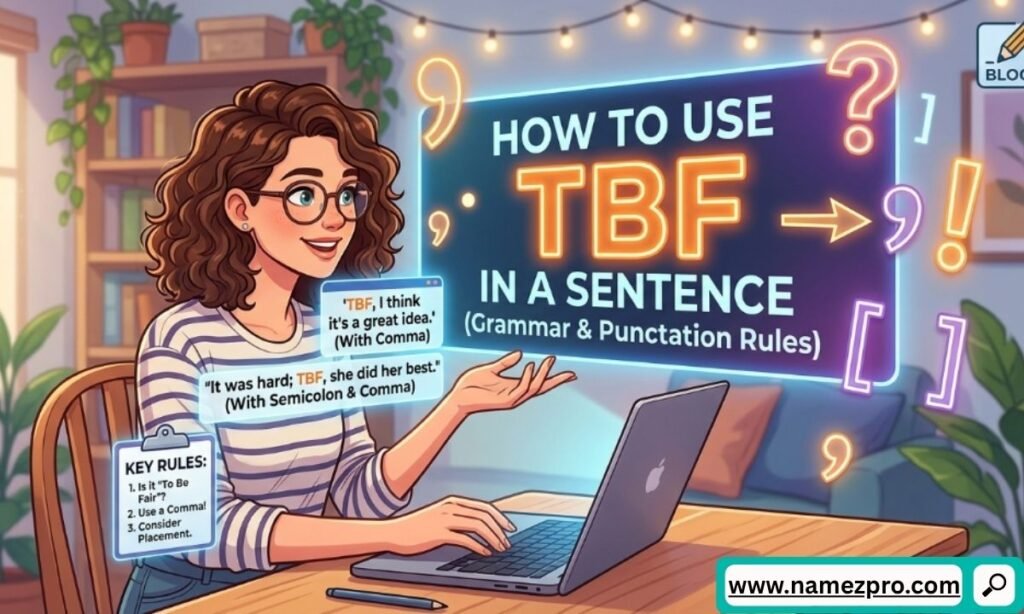
Nobody teaches punctuation for slang, yet small choices change how a message reads. TBF in texting behaves like an introductory phrase, so a comma usually follows it.
Comma and Capitalization Rules
Compare these two lines:
Tbf he did try his best. Tbf, he did try his best.
The second version reads smoother. It matches how people naturally pause after saying “to be fair” out loud. Skipping the comma isn’t wrong, since texting rarely follows strict grammar rules. Still, adding it makes the sentence easier to scan quickly.
Capitalization stays flexible too. At the start of a text, lowercase “tbf” reads casual and friendly. “TBF” in all caps feels a touch more emphatic, almost like the speaker wants the fairness point to land harder. Mid-sentence, lowercase is standard: “I mean, tbf, he warned us twice.”
Here’s a quick reference for common patterns:
| Example / Context | What It Means / How It Feels |
|---|---|
| “tbf, she’s had a rough week” | Soft, sincere, adds context before judging her |
| “TBF he did warn us” | Slightly firmer, almost like a mild correction |
| “I mean, tbf, it’s no big deal” | Casual mid-sentence hedge, relaxed tone |
| “tbf tho” | Trailing add-on, often sarcastic or half-joking |
The short version: treat TBF like any transitional phrase. Add a comma after it when it opens a sentence. Keep it lowercase in casual chat, and save the all-caps version for moments where extra weight helps the point land. Getting these small details right makes TBF meaning in text messages easier to send with confidence, instead of guessing at formatting on the fly.
TBF Compared to Other Texting Abbreviations
Compared with other texting abbreviations, TBF behaves a little differently on the page. “LOL” and “BRB” work fine standing completely alone, no comma needed, no real grammar to think about. TBF opens a fuller thought most of the time. It reads best when it’s punctuated like the phrase it’s replacing. Treating it as a mini clause rather than a stray abbreviation keeps your texting cleaner and easier for the other person to read at a glance.
Read Also: Alr Meaning in Text:What It Means, How to Use It, and Real Chat Examples
TBF Meaning in Text When It’s Just One Word, No Sentence After It
This is where most guides stop short, and it’s exactly where real confusion starts. A full sentence with TBF gives the reasoning behind the fairness. A bare “tbf” with nothing else gives you almost nothing but the shape of the reaction.
What a Lone “tbf” Signals
When someone sends only “tbf,” picture a small nod rather than a full explanation. It often means quiet agreement, a concession without wanting to spell out why. Someone hears your point and decides you’re not wrong. They don’t feel like typing three more sentences to prove it. This is where TBF meaning in text gets more complicated than a simple definition.
Look at the difference in weight here:
Maya: I told you the traffic would be bad. Leo: tbf, I should’ve left earlier.
Maya: I told you the traffic would be bad. Leo: tbf
Leo’s second reply carries less warmth and more resignation. The full sentence version sounds like an honest admission. The single word feels almost reluctant, like Leo agrees but isn’t thrilled about saying it out loud.
Five Real Exchanges Showing the Range
A few more conversation snippets showing the range:
Priya: You always forget my coffee order. Devon: tbf
Here, Devon isn’t defending himself. Devon is conceding quietly, perhaps a little embarrassed.
Alex: No way you ate the last slice. Jamie: tbf, I was starving.
Jamie softens the confession, giving a reason right alongside the concession.
Nina: You never text first. Omar: tbf
Short and slightly clipped. It reads a little defensive, without wanting a longer conversation about it.
If a lone “tbf” lands in your inbox and you want a warmer read of the room, try a simple follow-up question: “tbf what?” It often invites the other person to explain further, turning a flat reply into a real exchange instead of a guessing game.
If your Discord server or gaming squad still doesn’t have a solid name, our free Name Generator can knock out a handful of options in one go. Worth a look while you’re here.
Get instant name ideas no signup needed
TBF Meaning in Text Across Platforms: Discord, TikTok, Instagram, and More
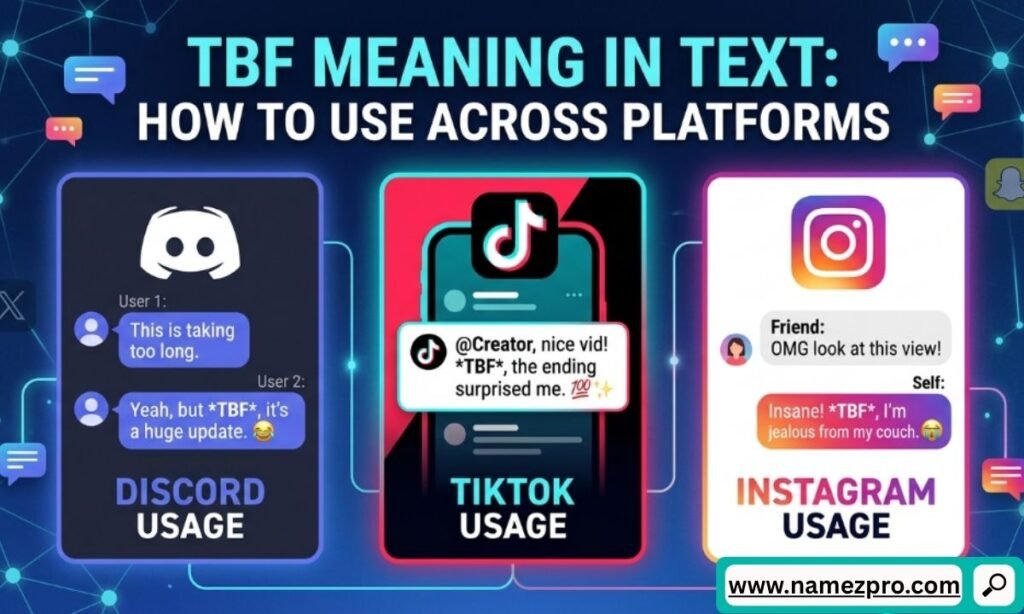
TBF meaning in text messages stays consistent everywhere, but the flavor shifts depending on where you see it.
Texting, WhatsApp, and Snapchat
On WhatsApp and regular SMS, TBF usually opens a quick clarifying thought inside a longer thread, especially in group chats sorting out plans. On Snapchat, it often shows up fast, tucked into a snap reply or a streak conversation. It matches the platform’s quick rhythm.
TikTok, Instagram, Twitter, and Reddit
TikTok comment sections use TBF constantly during debates under a video, where someone jumps in to defend a creator or a trend before the thread spirals. Instagram comments follow a similar pattern, especially under celebrity posts or viral moments. TBF often opens a counterpoint to whatever criticism came right before it.
Twitter (X) and Reddit lean a little more argumentative. TBF shows up mid-thread as a way to concede one small point while still holding the overall stance, a technique online debaters rely on constantly. On Reddit threads especially, TBF often signals someone stepping outside their usual camp to acknowledge the other side has a fair point.
Discord and Online Forums
One platform competitors rarely mention: Discord. Inside gaming servers, TBF shows up constantly during match debriefs and voice-chat follow-ups typed out afterward. A teammate might type “tbf, the lag was rough tonight” right after a lost match, softening blame while staying honest about what went wrong.
Online forums outside the big social apps follow the same pattern too. Long-running comment threads on hobby forums or news sites use TBF the same way Reddit does, conceding a small point mid-argument while holding the bigger position. Digital etiquette shifts slightly by platform. The underlying goal stays the same everywhere: keep the conversation moving while sounding fair rather than combative.
Read Also: SP Meaning in Text: What It Means in Chat, Social Media, and Texting
TBF vs TBH vs NGL vs IMO: What Separates Them
People toss these four abbreviations around like they’re interchangeable, and honestly, they aren’t doing the same job at all. Mixing them up is a fast way to blur TBF meaning in text messages during a real conversation.
The Core Difference
TBF (to be fair) points outward. It defends or explains someone else’s actions, or adds context to a situation being judged. TBH (to be honest) points inward. It signals the speaker’s own honest opinion, often about something personal or a little uncomfortable to admit. NGL (not gonna lie) works close to TBH, but carries a little more reluctance, like a confession the speaker would rather skip. IMO (in my opinion) stays neutral, marking a stance without defending anyone or confessing anything.
Here’s a side-by-side look:
| Example | What It Signals |
|---|---|
| “TBF, she had a lot going on this week” | Defending someone else, adding fairness |
| “TBH, I forgot your birthday” | Honest admission about the speaker |
| “NGL, I was a little jealous” | Reluctant, slightly embarrassed confession |
| “IMO, the sequel was better” | Plain opinion, no defense or confession attached |
Swap TBF for TBH in a sentence and the whole meaning shifts. “TBF, he forgot your birthday” defends him. “TBH, I forgot your birthday” confesses a personal mistake. Same three-letter shape on the surface, a completely different direction underneath.
Side-by-Side Examples
A common slip: using TBH when the sentence defends someone else instead of confessing something personal. If the sentence explains another person’s behavior, TBF fits. If it reveals the speaker’s own honest feeling, TBH fits better. Getting this right shows more emotional intelligence in a text thread than people usually give credit for.
One more real exchange to lock in the difference:
Kayla: You’re always on your phone during dinner. Ravi: TBF, work has been chaotic lately.
Ravi is explaining his own behavior while still leaning on the “fairness” framing rather than a plain confession. Swap it for “TBH, work has been chaotic lately,” and the sentence shifts from defending the habit to simply admitting it. It’s a subtle but real difference in how apologetic it sounds.
Reading the Tone: How TBF Meaning in Text Shifts From Genuine to Sarcastic
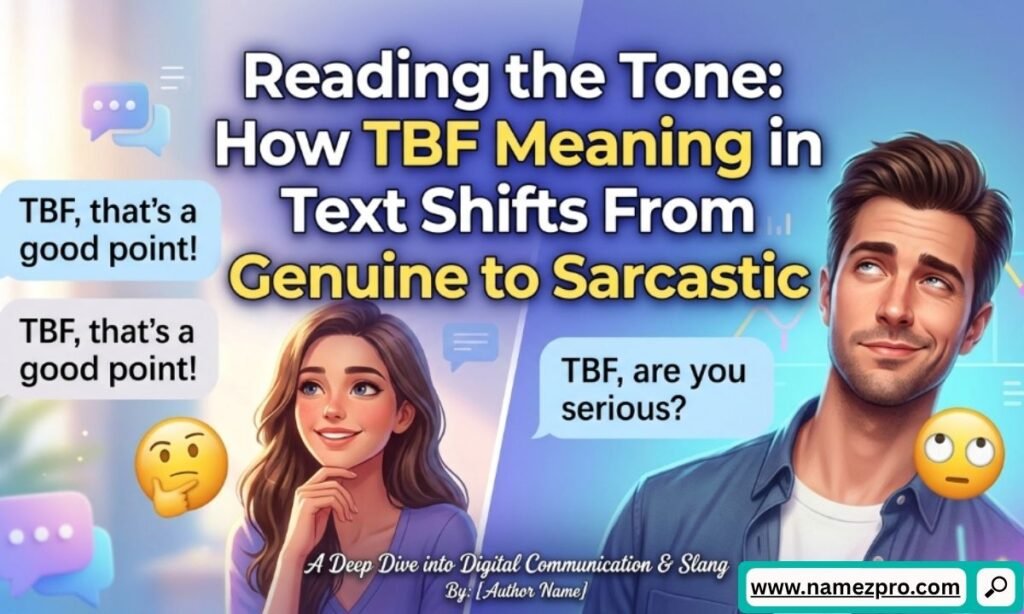
The TBF emotional tone depends heavily on what surrounds it, not the letters themselves. The same three letters carry warmth in one text and a sharp edge in another. Tone is where TBF meaning in text truly gets interesting, since context does more work than the word itself.
Genuine vs Sarcastic TBF
Genuine TBF usually sits inside a calm, unhurried sentence, often paired with a real reason. “tbf, she’s been dealing with a lot lately” reads sincere because it offers a specific, believable explanation. Sarcastic TBF tends to show up short and clipped, sometimes paired with an exaggerated or obviously ironic follow-up. “tbf, he’s a total genius,” said right after someone messes up spectacularly, flips the meaning entirely, turning praise into a joke.
Passive-aggressive TBF often trails at the end of a message rather than opening it, almost like an afterthought jab. “You showed up two hours late again. tbf.” lands cold, closer to a dismissal than a fair-minded comment.
A few more examples worth comparing:
Rachel: The presentation went badly. Theo: tbf, nobody had enough time to prepare.
This reads sincere, offering a real shared reason.
Bianca: He said he’d call and never did. Priya: tbf, he’s consistent at least.
Dry and a little sarcastic, poking fun rather than genuinely defending him.
How Punctuation and Emoji Shift the Reading
Reading tone accurately comes down to timing, punctuation, and what sits right before or after the word. A period right after “tbf” tends to feel colder than a comma leading into a full explanation. An emoji softens it further. A laughing emoji next to “tbf” almost always signals playful rather than sincere.
Read Also: MyB Meaning in Text: What It Really Means in Chats and Social Media
When TBF Meaning in Text Doesn’t Belong (Workplace & Formal Etiquette)
TBF professional use comes with real limits. Slack messages, work emails, and texts to an older relative call for a different approach than a group chat with friends.
Work Chat and Professional Emails
Dropping “tbf” into a serious work conversation risks sounding careless, even when the point behind it holds up. A manager reading “tbf, the deadline was unrealistic” might focus more on the casual tone than the valid concern buried inside it. Spelling out “to be fair” in full reads more polished. It removes any risk of a coworker misreading the abbreviation entirely.
Professional emails sit in a gray zone worth calling out separately. A quick internal email between two coworkers who text casually might tolerate “tbf” without raising an eyebrow. Anything client-facing, anything going to leadership, or anything tied to a performance discussion reads better fully spelled out. Email threads tend to outlive the conversation around them, getting forwarded, saved, and reread. Defaulting to full phrasing protects you from a slang choice looking careless months later.
Family Chats and Formal Writing
Formal writing, academic papers, and legal documents rule out TBF completely. These settings expect full, precise language. Slang shortcuts, however common in everyday texting, undermine the tone a formal document needs.
Family group chats sit somewhere in the middle. Grandparents and older relatives often don’t recognize the abbreviation at all, leading to confusion rather than clarity. Spelling out the phrase avoids an awkward follow-up explaining what three random letters mean.
A helpful rule of thumb: save TBF for casual texting, friend group chats, and social media comments. Switch to the full phrase anywhere tone, professionalism, or clarity carries real weight, like performance reviews, client emails, or a first message to someone new online. Knowing TBF meaning in text doesn’t mean it belongs in every setting. Reading the room still matters more than the definition itself.
Frequently Asked Questions
What does TBF mean in a text message?
TBF means “to be fair.” People use it to soften an opinion, add context, or defend someone before a judgment gets made. It works the same way across texting, DMs, and comment sections.
Is TBF rude or sarcastic?
TBF isn’t rude by itself. Tone, punctuation, and what follows it decide whether it reads sincere or sarcastic. The same three letters land differently depending on the sentence around them.
What’s the difference between TBF and TBH?
TBF defends or explains someone else’s situation, while TBH shares the speaker’s own honest opinion or admission. Mixing the two up is an easy way to accidentally change the meaning of a message.
Does TBF mean something different on Discord or in gaming chats?
The core meaning stays the same. On Discord it shows up often during match debriefs, softening blame while staying honest about what went wrong after a rough round.
Is it okay to use TBF at work?
A casual Slack message between close coworkers might be fine. Formal emails, client messages, and performance reviews call for the full phrase instead, since slang tends to read as careless in writing people keep around.
TBF Meaning in Text: The Bottom Line
Here’s the short answer: TBF stands for “to be fair.” Once you see it in real conversations, the confusion clears up fast. The trickier part isn’t the definition. It’s reading whether someone sending a bare “tbf” means quiet agreement, a joke, or a small jab.
Next time a text lands with nothing but “tbf,” look at what came before it, how it’s punctuated, and whether an emoji softens the blow. TBF meaning in text messages boils down to context every single time, whether it shows up in a Snapchat reply, a Discord debrief, or a group chat sorting out weekend plans.
Bottom line: three letters, one flexible tone, and a phrase softening arguments long before texting existed at all. Reading it well is a small communication skill. It saves real misunderstandings, whether you’re smoothing over a group chat disagreement or replying to a coworker who dropped a lone “tbf” and left you guessing.
Now that you’ve got the slang down, your next group chat, gamer tag, or online alias deserves a name that actually fits. Our free Name Generator is right here whenever you want to try it.
Get instant name ideas no signup needed