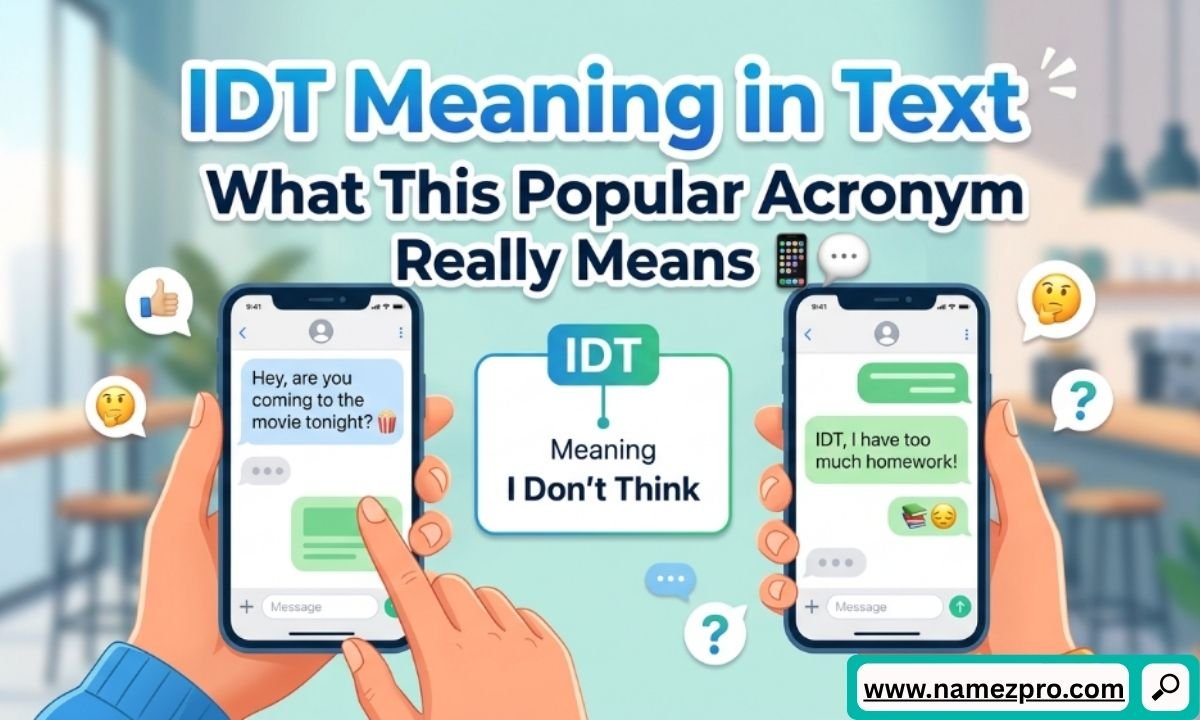
You’re mid-conversation and someone drops “IDT” and you freeze. The IDT meaning in text confuses a lot of people, especially when the IDT definition shifts based on context and platform. IDT stands for “I Don’t Think,” a fast way to express doubt or soft disagreement in digital communication. It fits perfectly into internet slang culture where shorter always wins. Whether it appears in casual conversations, online communities, or dating apps, the IDT acronym packs a full thought into three letters. This guide covers the complete IDT explanation, including social media use, gaming contexts, professional communication rules, and even hidden meanings you might not expect.
What Does IDT Mean in Text? The Clear Definition
IDT meaning in text is simple. IDT stands for “I Don’t Think.” It’s one of the most widely used alternative acronyms for expressing doubt or gentle disagreement in online messaging.
Quick Answer: IDT = “I Don’t Think.” Use it when you want to push back softly without fully committing to a “no.”
People reach for IDT to soften a response without sounding blunt. Instead of saying “no” flat out, IDT keeps relaxed dialogue flowing. Here’s what IDT means across different forms:
| IDT Usage | What It Communicates |
|---|---|
| IDT so | Mild doubt, “probably not” energy |
| IDT that’s right | Polite correction or pushback |
| IDT I can make it | Soft decline without full commitment |
| IDT lol | Casual, humorous disagreement |
| IDT… (trailing) | Uncertainty, still thinking it through |
Beyond texting, IDT spreads into virtual conversations on Reddit, Discord, and across social networks. It’s one of those related abbreviations that jumped from SMS into every corner of digital platforms.
Read Also: ILY Meaning in Text: What This Heartfelt Acronym Really Means 💕📱
IDT Meaning in Text: Real-World Examples From Actual Conversations
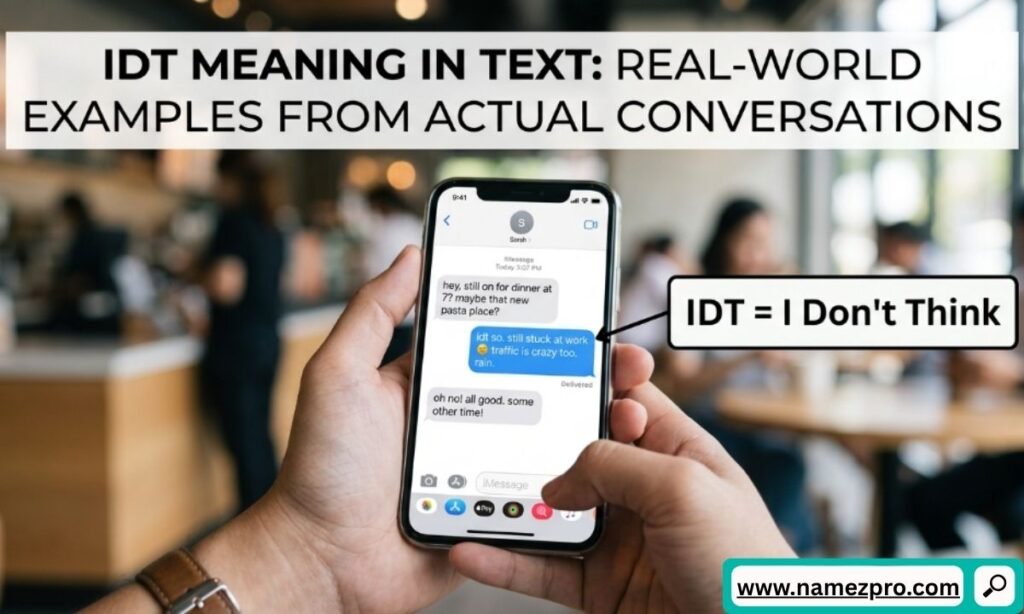
The IDT meaning in text stays consistent, but how it lands depends on setting. The IDT acronym shows up across informal chats, group threads, and busy online platforms.
These are real-style examples across different settings:
| Scenario | Example | Tone |
|---|---|---|
| Friend to friend | “IDT we’ll finish this tonight” | Relaxed, honest |
| Group chat | “IDT that movie deserved the hype” | Casual opinion |
| Instagram comment | “IDT this collab works tbh” | Public pushback |
| Twitter/X reply | “IDT the numbers add up here” | Skeptical, direct |
| Discord server | “IDT we’re winning this lol” | Self-deprecating |
In a Facebook post comment, IDT reads as a public opinion. In a DM, it feels personal and honest. That gap matters.
Short conversations move fast. IDT helps people keep up without typing full sentences. That’s the whole point of internet slang: say more with less. Context, relationship, and timing all shape how the other person receives it.
IDT vs. IDK vs. IMO: What’s the Real Difference?
These three get mixed up constantly. They’re comparable phrases, but each one does a different job in electronic communication. Getting the IDT meaning in text right means knowing exactly which one fits your situation.
Here’s the clearest breakdown:
| Acronym | Full Form | Best Used When |
|---|---|---|
| IDT | I Don’t Think | You have an opinion but want to stay polite |
| IDK | I Don’t Know | You genuinely have no answer |
| IMO | In My Opinion | You want to own your take confidently |
| IDC | I Don’t Care | The topic doesn’t affect you |
| TBH | To Be Honest | You want to be direct or sincere |
The key difference between IDT and IDK: IDT signals you have a leaning. IDK means you have zero read on it. If someone asks “Do you think she’s upset?” and you say IDT, you’re implying you lean toward “no.”
IMO is confident. IDT is cautious. Both are synonymous expressions for sharing views, but the energy is completely different. Mixing these up creates unnecessary confusion in text-based talk.
Read Also: LMAO Meaning in Text Explained Clearly for Social Media Users 😂
IDT Meaning in Text Changes With Tone: How Context Shifts Everything
The IDT meaning in text is not just about the words. Tone in texting gets shaped by punctuation, emojis, and context. Understanding IDT meaning in text at this level separates confident texters from confused ones.
Look at these examples, all using IDT, all meaning something different:
| IDT Variation | Tone It Sends | What the Reader Feels |
|---|---|---|
| IDT. (period only) | Cold, firm, closed off | Mild tension |
| IDT lol | Light, jokey, unbothered | Relaxed, easy |
| IDT? | Confused or second-guessing | Open to being corrected |
| IDT 😬 | Awkward, uncertain | Sharing discomfort |
| IDT tbh | Honest, straightforward | Candid and direct |
| IDT! | Surprised pushback | Slightly defensive |
A period after IDT shuts a conversation down. “IDT lol” keeps it going. One character flips the entire dynamic.
This matters in digital communication because you lose vocal cues. No tone of voice. No facial expression. Punctuation and emojis carry all of that weight, IDT used sarcastically reads completely differently than IDT used sincerely.
IDT Meaning in Text Across Social Media, Gaming, and Online Communities
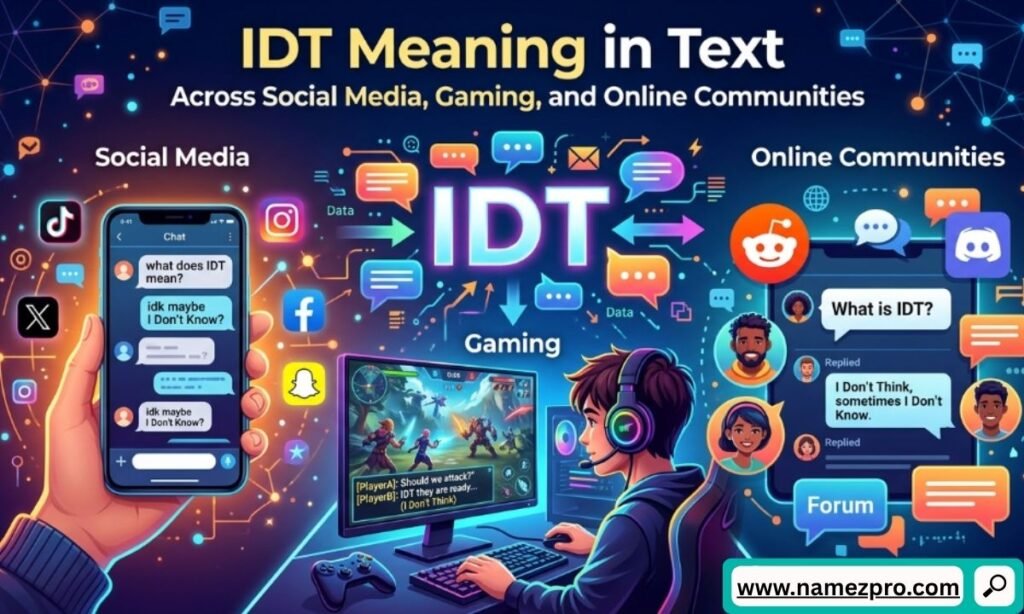
IDT started in SMS culture but spread fast. Today it lives across every corner of the internet, from Twitter Instagram comments to Discord servers. The IDT meaning in text stays consistent, but tone shifts by platform.
Here’s where you’ll spot it most:
| Platform | How IDT Gets Used |
|---|---|
| Twitter/X | Hot take pushback in replies |
| Comment section opinions on Reels | |
| Reddit forums | Gentle disagreement in threads |
| Discord servers | Casual chat during gaming sessions |
| Facebook posts | Picked up from younger family members |
| TikTok comments | Fast, punchy reactions to videos |
In gaming groups and multiplayer interactions, IDT pops up between rounds. Players use it to express doubt about strategy or match outcomes. It fits the fast pace of player chats perfectly.
Fun Fact: IDT is one of the few texting acronyms that works in voice-to-text. Gen Z actually says “I D T” out loud in voice messages now.
IDT Meaning in Text vs. Professional Settings: When to Stop Using It
The IDT meaning in text works perfectly in personal chats, but the moment you’re in a work setting, it signals the wrong level of care. IDT does not belong in professional communication.
Formal emails, business writing, and official correspondence demand clear, complete language. Here’s how to swap IDT for the right phrase in corporate language:
| Casual IDT Usage | Professional Alternative |
|---|---|
| “IDT this plan works” | “I have concerns about this approach” |
| “IDT we’ll hit the deadline” | “I’m not confident we’ll meet the deadline” |
| “IDT that’s right” | “I’d like to revisit that point” |
| “IDT this is a good idea” | “I’d recommend we explore other options” |
| “IDT anyone agrees” | “There may not be consensus on this yet” |
Academic papers, business reports, and structured language contexts expect precision. IDT is too ambiguous for high-stakes settings.
Common Mistake: Gen Z professionals sometimes carry texting habits into their first jobs. Using IDT in Slack or email with a senior colleague reads as unprofessional, even if it wasn’t intended that way.
Why People Choose IDT in Text: The Psychology of Soft Disagreement
Here’s something most articles skip entirely. Why do people choose IDT over simply saying “no”?
Written words feel permanent. A spoken “no” fades. A typed “no” sits there and stares back at you. IDT softens the blow and leaves the door open for the other person to respond without feeling attacked.
Here’s how IDT functions emotionally across different situations:
| Situation | Why IDT Works Better Than “No” |
|---|---|
| Declining a plan | Feels less final, leaves room for compromise |
| Correcting someone | Softer than “that’s wrong” |
| Expressing doubt | Honest without being harsh |
| Group chat disagreements | Prevents the thread from getting heated |
| Romantic conversations | Avoids shutting someone down cold |
Researchers call this “epistemic hedging.” You’re not saying you’re right. You’re saying you lean a certain way. That’s a low-risk position in everyday talks and friendly discussions.
A flat “no” in a group chat derails the whole thread. IDT lets you register your position without starting a debate.
Read Also: IIRC Meaning in Text: What This Popular Acronym Really Means 📝💬
Got an IDT in Text? Here’s Exactly How to Respond
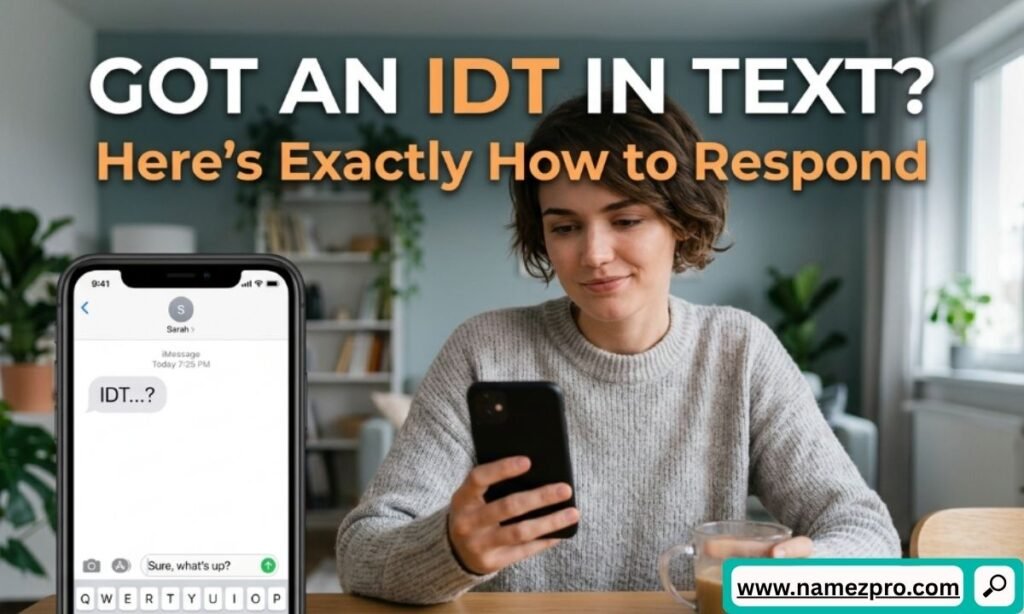
Getting an IDT from someone is a cue, not a dead end. How you respond shapes where the conversation goes next.
Here are the smartest reply strategies by situation:
| Their IDT Message | Your Best Reply |
|---|---|
| “IDT I can make it tonight” | “No worries, let’s reschedule” |
| “IDT that’s a good idea” | “What’s your concern? I’m open to it” |
| “IDT so lol” | “Fair, what do you think instead?” |
| “IDT you’re right about that” | “Walk me through your thinking” |
| “IDT this is working” | “What would make it work better?” |
You’re not fighting the IDT. You’re inviting more. That keeps non-formal talk going instead of shutting it down.
If someone uses IDT sarcastically, match the energy. If it’s genuine doubt, take it seriously and ask a follow-up. This is often a soft request for you to make a stronger case.
Read Also: IONK Meaning in Text: Complete Guide to This Viral Slang
IDT Meaning in Text for Gen Z: How This Slang Evolved Over Time
IDT didn’t start with Gen Z. It traces back to MSN Messenger and AIM in the early 2000s, when character limits and tiny keyboards made short phrases essential.
Back then, IDT was purely functional. Less typing, same message.
But Gen Z transformed it. They layered irony and exaggeration onto IDT in ways earlier users never did. “IDT I’ve ever eaten better” doesn’t express doubt. It means the food was incredible and the person is being ironic.
| Era | How IDT Was Used | Dominant Platform |
|---|---|---|
| Early 2000s | Pure shorthand | MSN, AIM |
| 2010s | Standard texting shortcut | SMS, WhatsApp |
| Early 2020s | Casual doubt marker | Twitter, Instagram |
| Now (Gen Z) | Irony, humor, self-deprecation | TikTok, Discord |
Cultural variations play a role too. In some international contexts, IDT reads as a direct phrase without the irony layer. Language differences and local adaptations mean the tone doesn’t always cross cultures cleanly.
Other Things IDT Stands For Beyond Texting
The IDT acronym has a life outside of texting. Depending on the setting, the IDT explanation shifts completely.
Here are the other common meanings:
| IDT Meaning | Context | Who Uses It |
|---|---|---|
| I Don’t Think | Texting, social media, casual talk | General public, Gen Z |
| IDT Corporation | Telecom and financial services | Business and finance |
| Integrated Device Technology | Tech and semiconductors | Engineers, tech pros |
| Intrusion Detection Tool | Cybersecurity | IT and security teams |
| Interactive Digital Television | Broadcasting and media | Media industry |
When a colleague says IDT in a meeting, they probably mean the telecom company. When your friend texts IDT, they mean “I Don’t Think.” Context is everything.
Did You Know? IDT Corporation was founded in 1987 and is publicly traded. So if your boss mentions IDT in a finance meeting, it’s definitely not texting slang.
Always read context before assuming which IDT definition applies.
FAQs
IDT stands for “I Don’t Think.” It expresses doubt, soft disagreement, or uncertainty in informal text conversations.
No. IDT means “I Don’t Think,” implying you have a leaning. IDK means “I Don’t Know,” signaling you have no answer yet.
Example: “IDT we’ll make it in time, traffic is bad.” Use it at the start of a sentence to soften a doubtful opinion.
Not usually. IDT is soft by nature. But with a harsh tone, it reads as dismissive. Pair it with a reason when the stakes are higher.
Same meaning: “I Don’t Think.” Gen Z on TikTok sometimes uses it ironically, so read the comment’s tone carefully.
Completely informal. Never use IDT in formal emails, business writing, or professional documents.
It means “I don’t think so.” A short, casual way to say “probably not” without sounding blunt.
Final Thoughts
IDT meaning in text is simple on the surface: “I Don’t Think.” But the way people use it, the tone it carries, and the platform it lives on make it far more layered than three letters suggest.
It softens disagreement. It signals doubt without slamming a door shut. Gen Z evolved it into a tool for irony, humor, and personality. In digital communication where tone is easy to misread, IDT gives people a low-risk way to push back.
Use it freely in casual conversations, online communities, and informal chats. Keep it away from formal emails, professional communication, and business writing.
Now you know exactly what IDT means, where it fits, and how to use it right.