My coworker sent me a text at 9 PM on a Thursday night. It said: “FYI, you submitted the wrong file.” That was it. No context, No emoji. No “hope you’re doing okay.” I stared at my phone for a full 30 seconds trying to figure out if she was being helpful or throwing shade from across town. If you’ve ever gotten a message like that and felt the exact same confusion, you already know why understanding FYI meaning in text matters more than you think. It’s not always as straightforward as three little letters suggest. This article breaks down what FYI means, where it came from, why it sometimes sounds rude even when it isn’t, and how to use it without accidentally starting a cold war in your group chat.
What Does FYI Mean in Text?
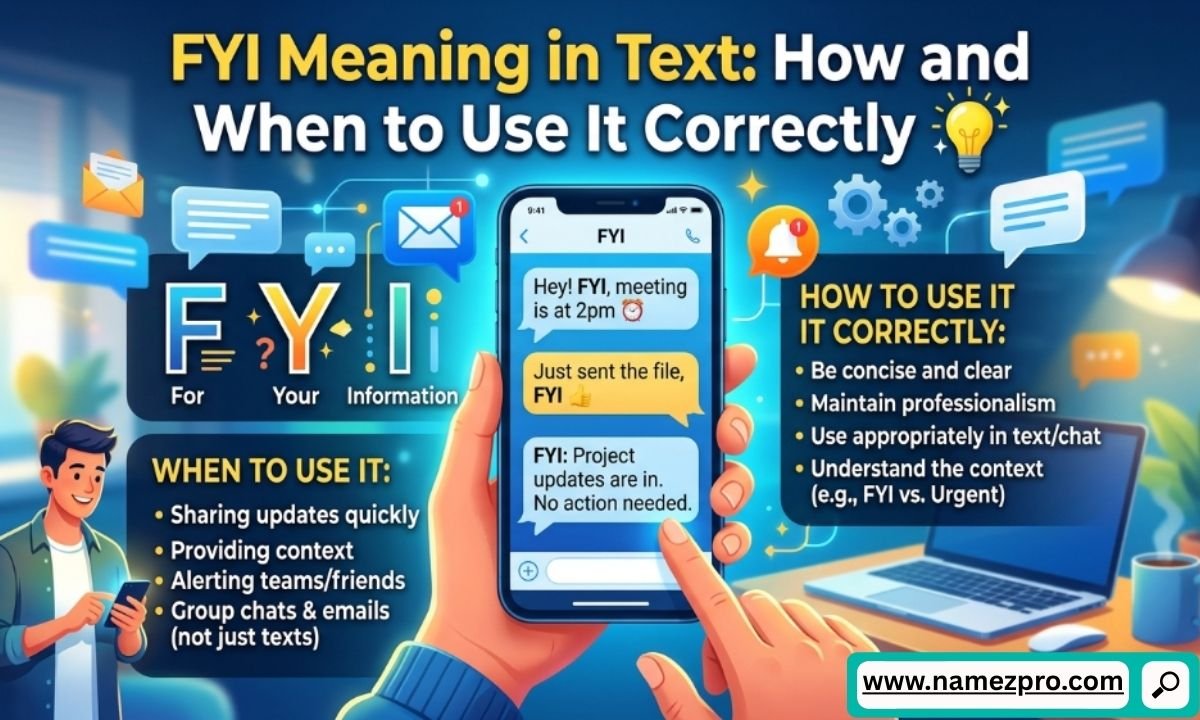
FYI stands for “For Your Information.” It ranks among the most recognized texting acronyms in all of digital communication, and its fyi definition is refreshingly simple: you’re sharing a piece of information with someone who might want to know it. No action required. No response expected. You’re passing along an update and leaving the ball entirely in their court.
The short answer is that FYI is a neutral, pressure-free signal. It differs from urgent texting acronyms like ASAP or ATTN in one key way: those two demand something from the reader. FYI meaning in text does the opposite. It’s calm, informative, and carries zero urgency.
Here’s how FYI plays out in real conversations:
Conversation 1:
Jake: FYI, the gym closes at 8 tonight instead of 10. Mia: Oh good to know, thanks!
2nd Conversation:
Mom: FYI your package is at the front door. You: 👍
Conversation 3:
Boss: FYI, the client pushed the meeting to Thursday. Employee: Got it, I’ll update my calendar.
Notice how none of those exchanges demand a specific action or response. The sender shares the information and walks away. That’s the whole point of the fyi acronym. It’s an informational handoff, nothing more.
People drop FYI in text messages, email threads, Slack channels, and Instagram comments. The fyi full form stays consistent across all platforms, but the tone shifts depending on context, and that’s where things get interesting.
Read Also: XD Meaning in Text: What This Fun Emoticon Really Means 😆💬
The Real Origin of FYI: From Office Memos to Text Messages
Most people assume FYI is a millennial text invention. It isn’t. Not even close.
The fyi acronym traces its roots back to mid-20th century American office culture. Business professionals in the 1940s and 1950s wrote paper memos packed with abbreviations to save time and space. “FYI” appeared regularly in those internal notes as a quick way to flag that a piece of information was being shared without requiring a formal response or action.
Did You Know: FYI appeared in U.S. government and White House memos as early as the 1940s, making it one of the oldest office acronyms still actively used in digital communication today.
When fax machines arrived in the 1970s and 1980s, FYI made the jump with them. Then came email in the 1990s, and FYI slid right into subject lines and message bodies without missing a beat. Early internet chat platforms like AOL Instant Messenger introduced FYI to a younger and more casual audience who had never typed a business memo in their lives.
By the time SMS texting went mainstream in the early 2000s, FYI was already established vocabulary. It didn’t need to be invented for texting. It evolved into it, carrying its office-born neutrality straight into the palms of a new generation.
That’s exactly why FYI meaning in text feels so natural to use. It’s a phrase built for information sharing, and it has been doing that job for over 80 years. Most internet slang burns out within a few years. FYI keeps going. That kind of staying power tells you everything about how useful a genuinely neutral phrase becomes in everyday communication.
FYI in Texting, Email, and Social Media: Does the Platform Change the Meaning?
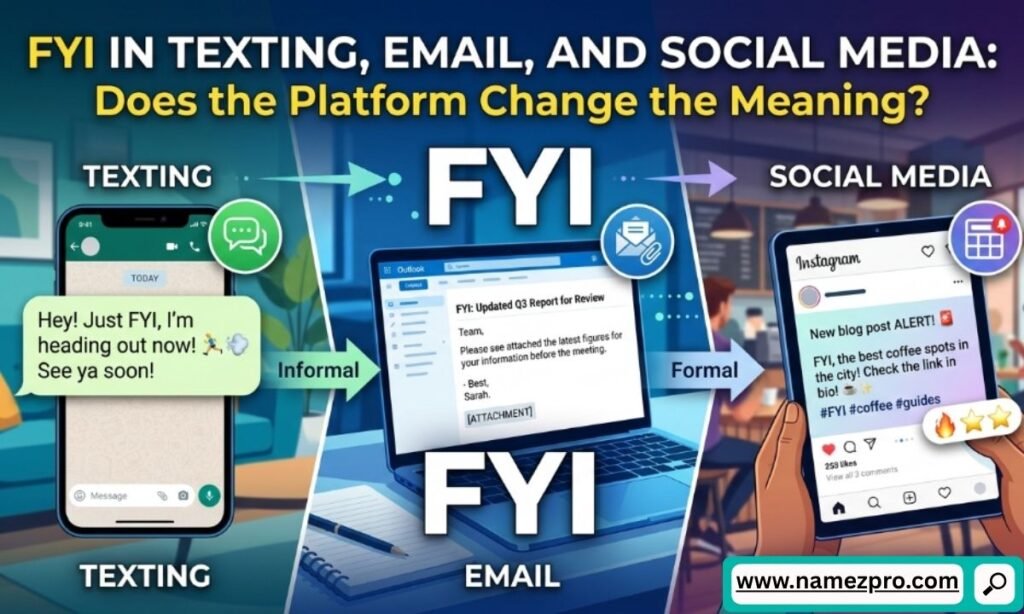
The fyi usage stays rooted in the same definition across platforms, but the vibe shifts depending on where you drop it. A FYI in a work email reads completely differently from a FYI in a TikTok comment, even though the letters are identical.
Here’s how FYI lands across different digital spaces:
| Platform | How FYI Typically Lands |
|---|---|
| Text message | Casual heads-up between friends or family |
| Workplace email | Professional update, no reply needed |
| Slack or Teams | Quick internal team alert |
| Instagram comment | Corrections, fun alerts, or fact-checks |
| TikTok comment | Often ironic, corrective, or satirical |
| Twitter/X | PSA-style posts, serious or tongue-in-cheek |
Conversation 4 (Instagram comment):
Post caption: “Avocados are a vegetable!” Comment: “FYI, avocados are technically a fruit. 🙃”
Conversation 5 (Work Slack):
Priya: FYI the Monday standup is canceled. Enjoy the extra sleep. Team: 🙌🙌🙌
On TikTok and Twitter, FYI meaning in text and social captions carries a noticeably corrective or sarcastic edge. On personal texts and work emails, it stays clean and neutral. Reading the platform tells you half of what you need to know before you even read the rest of the message.
Read Also: White Heart Emoji Meaning: Love, Support, Purity, and More
Is FYI Passive-Aggressive? When It Sounds Rude and When It Doesn’t
Here’s the thing: this is the question most articles on FYI meaning in text completely skip over, and it’s the one that matters most.
FYI is neutral by design. But placed inside the wrong sentence, it hits like a passive-aggressive sucker punch. The acronym itself isn’t rude. The sentence carrying it does the damage.
Read these two messages out loud:
“FYI, the meeting moved to 3 PM.”
“FYI, you forgot to CC me again.”
The first one is helpful. The second one stings, even without a single angry word. The information is the weapon, and FYI is holding it.
Here’s what turns FYI from neutral to passive-aggressive:
- Pointing out someone’s mistake without offering any help alongside it
- Sending it with no greeting or softening language around it
- Using it to “inform” someone they’re wrong, in a public chat
- Pairing it with cold punctuation like a lone period and nothing else
The sarcastic FYI is its own category entirely. Gen Z uses it with deliberate deadpan energy, especially in social media comments and group chats:
“FYI, nobody asked.” “FYI, that ship sailed in 2019.”
Those uses flip the neutral tone entirely. The fyi acronym becomes a vehicle for shade rather than genuine information sharing. To keep FYI friendly, pair it with warm language or a light emoji. “Hey, FYI the store closes early today! 😊” lands in a completely different place than “FYI the store closes early.” One tiny addition changes the whole message.
Uppercase FYI vs. Lowercase fyi: Does Capitalization Matter at All?

Yes, and this is one of those small texting details that nobody talks about enough.
Capitalization in texting carries real emotional weight. How you write FYI signals almost as much as the words around it. Here’s the full breakdown:
| Version | Tone | When to Use |
|---|---|---|
| FYI | Neutral, standard | General updates, professional messages |
| fyi | Softer, more casual | Friendly texts, laid-back chats |
| FYI! | Enthusiastic or urgent | Exciting news, important alerts |
| FYI… | Trailing, often ominous | Sarcasm, bad news buildup |
Read these four versions and feel the difference:
“fyi the party starts at 8” (chill, relaxed) “FYI the party starts at 8” (informative, clean) “FYI the party starts at 8!” (excited, high energy) “FYI… the party starts at 8.” (something is clearly wrong here)
The lowercase fyi signals you’re relaxed and unbothered. The standard uppercase FYI is your go-to for most digital communication. The ellipsis version creates instant tension, whether that’s intentional or not. One trailing dot turns a simple update into a slow-burning warning.
This layer of FYI meaning in text gives you full control over how your message lands. A single punctuation choice separates “helpful friend” from “ominous warning.” Don’t let an accidental period make you look shady when you’re trying to be genuinely kind.
Read Also: IDT Meaning in Text: What This Popular Acronym Really Means 📱💬
How Gen Z and Millennials Use FYI Differently
Both generations use FYI, but the usage patterns are noticeably different once you start paying attention.
Millennials picked up FYI from email and early instant messaging culture. They lean toward using it in a professional-adjacent way, even in casual texts. For most Millennials, FYI is a clean and efficient information handoff with no drama attached.
“FYI, I already booked the restaurant for Friday.”
Gen Z treats FYI with considerably more irony and social commentary. It shows up in TikTok captions, comment sections, and group chats as a tool for correction, shade, or deadpan humor. FYI meaning in text shifts for Gen Z from a neutral update to a knowing, often pointed signal.
“FYI, that ‘life hack’ has been debunked three times. 💀”
Gen Z also pairs FYI with specific emojis to nail down the exact tone. The emoji carries emotional weight that three capital letters alone won’t deliver. Here are the most common FYI pairings and what they communicate:
- FYI 💡 = helpful tip or genuine information
- FYI 📢 = important announcement, pay attention
- FYI 🙃 = sarcasm or light but deliberate shade
- FYI 👀 = something worth closely watching
Recognizing these generational patterns helps you decode whether someone is being a helpful friend or doing the digital version of a slow clap, FYI meaning in text carries different weight depending on who’s sending it and how old their Spotify account is.
FYI Alternatives and Similar Slang Terms You Should Know
FYI isn’t the only common acronym doing this job in digital communication. Several texting acronyms share similar territory but carry different tones and levels of formality. Knowing which one to reach for makes your messaging sharper and more intentional.
Here’s how the main alternatives stack up:
| Acronym | Stands For | Tone | Best Used For |
|---|---|---|---|
| FYI | For Your Information | Neutral | General updates across all platforms |
| JFYI | Just For Your Information* | Softer, friendlier | Casual corrections between friends |
| BTW | By The Way | Casual side note | Informal conversations only |
| PSA | Public Service Announcement | Serious or satirical | Social media posts |
| ICYMI | In Case You Missed It | Helpful, not pushy | Reminders and recaps |
| NGL | Not Gonna Lie | Direct, honest | Personal opinions and admissions |
| TBH | To Be Honest | Candid | Personal takes and reviews |
ICYMI and FYI are the closest cousins in this group. The difference comes down to timing. FYI shares fresh information the recipient hasn’t heard yet. ICYMI resurfaces something that already happened or was already shared and the recipient missed it.
Not all of these work in professional settings. FYI, BTW, and ICYMI are safe for workplace emails and Slack messages. PSA works well on social media. NGL and TBH belong in personal conversations and nowhere near a business email.
Read Also: ILY Meaning in Text: What This Heartfelt Acronym Really Means 💕📱
How to Respond to an FYI Text the Right Way
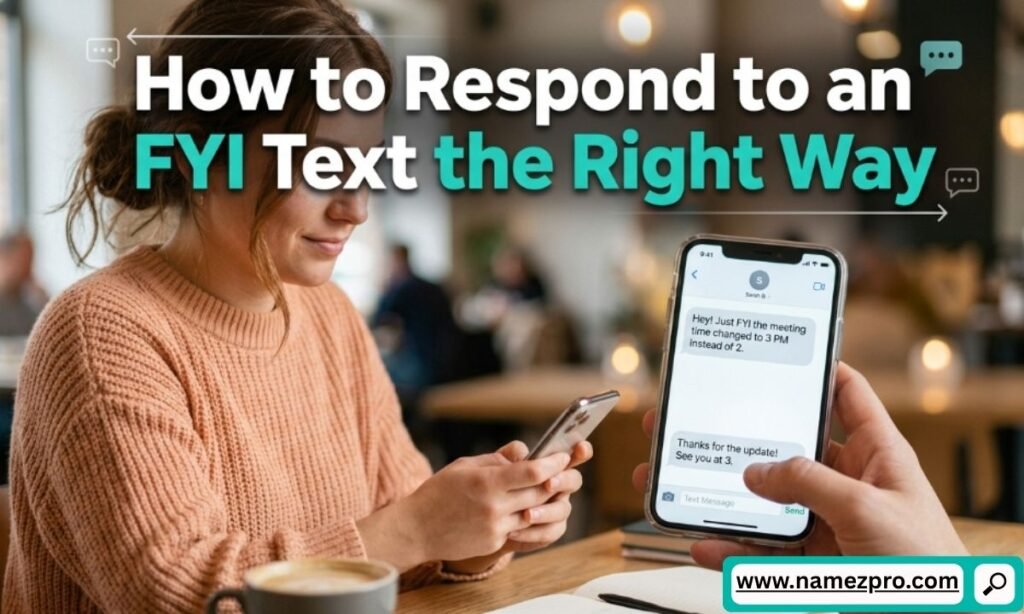
FYI doesn’t require a reply. That’s the entire design of the acronym. But staying silent sometimes feels awkward, especially in a professional setting or when you want to acknowledge someone who took the time to give you a heads-up.
The right response depends on your relationship with the sender and the platform you’re on.
In casual texting:
- “Thanks for the heads-up!” (warm and simple)
- “Good to know!” (friendly and light)
- A thumbs-up or any relevant emoji (perfectly fine)
- “Oh wow, didn’t know that!” (works great for surprising info)
In work communication:
- “Thanks for the update.” (clean and professional)
- “Noted, I’ll adjust accordingly.” (shows you acted on it)
- “Received, thank you.” (formal, appropriately brief)
Conversation 6:
Coworker: FYI, the Q3 deadline moved up to the 10th. You: Got it, thanks for letting me know!
That response is perfect. Clean, warm, professional. It acknowledges the message without turning an FYI into a 12-message thread.
What you want to avoid is treating an FYI like an urgent request. Don’t fire back with three follow-up questions or a long explanation unless the original message genuinely warrants it. An FYI is not an invitation for a full conversation unless the sender’s wording signals otherwise. Respect what the word was designed to do.
Read Also: SS Meaning in Text: Hidden Meanings Behind This Viral Acronym 🚀
Is FYI Still Professional in 2025? Using It Correctly in Work Settings
FYI holds up well in most professional digital communication. Workplace email and team messaging platforms like Slack have made FYI a completely accepted phrase in office culture, and that’s unlikely to change anytime soon.
Here’s where FYI works well in professional settings:
- Email subject lines: “FYI: Updated Project Timeline”
- Slack or Teams messages: “FYI, the client call is pushed to next week.”
- Forwarded emails that need no action: “FYI, see the attached report.”
- Internal memos shared for team awareness only
Here’s where FYI doesn’t belong:
- Formal business letters sent to external clients
- Legal or academic documents
- Official reports submitted to executives or board members
- Any correspondence going outside the organization
In formal writing, swap FYI for polished phrases like “Please note that,” “For your reference,” or “I wanted to bring to your attention.” These carry the same informational weight with a more appropriate tone for high-stakes documents.
The key with FYI in professional settings is knowing your audience before you type. Your team Slack? FYI fits perfectly. A report going to a board of directors? Write it out in full. FYI meaning in text and digital messaging is universally understood, but formal documents still benefit from complete, professional sentences every time.
Frequently Asked Questions
FYI means “For Your Information” regardless of who sends it. The person is sharing something they think you should know. There’s no hidden romantic meaning attached to the acronym unless the rest of the conversation suggests otherwise.
FYI means “For Your Information” regardless of who sends it. The person is sharing something they think you should know. There’s no hidden romantic meaning attached to the acronym unless the rest of the conversation suggests otherwise.
FYI itself isn’t rude. The tone comes from the sentence surrounding it. “FYI, you made a mistake” hits quite differently from “FYI, the meeting moved to 3 PM.” Adding warm language or a friendly emoji keeps FYI from sounding cold or pointed.
No reply is required. FYI signals an informational message with no action needed. A quick “Thanks!” or a thumbs-up emoji is always a thoughtful touch if you want to acknowledge the message, but it’s entirely optional.
FYI shares new information the recipient hasn’t heard yet. ICYMI (In Case You Missed It) resurfaces something that was already shared or that already happened. Use FYI for fresh updates and ICYMI when you’re bringing back something the person missed.
FYI works well in most workplace emails and team chats. For highly formal documents, external client correspondence, or official reports, use full phrases like “Please note” or “For your reference” to keep the tone appropriately polished.
Conclusion
FYI is three letters doing a surprisingly heavy job in digital communication. It shares information without pressure, signals a heads-up without demanding a reply, and travels comfortably between personal texts, work emails, and social media posts. The catch is that tone, capitalization, and context are everything. A friendly “fyi 💡” and a cold “FYI.” live in completely different emotional universes, even though they share the same fyi meaning in text on paper. Next time you see FYI in a text, you’ll know exactly what to say back.